
The most consequential AI decisions your organisation will make in the next three years will be made by your CEO and your board — often without access to the quality of strategic counsel those decisions demand.
Dr. Andrée Bates works with a small number of pharmaceutical and biotech CEOs and boards each year as a personal strategic advisor on AI. Not as a consultant. Not as a project lead. As the most experienced pharma AI mind available to your leadership, directly — in the room, on the call, at the table where the decisions are made.
Your board has governance responsibility for your AI direction. Most pharma boards are making those decisions without a single person in the room who has spent twenty years doing this.
The pressure on pharma boards around AI has intensified sharply. Shareholders and investors are asking whether the organisation has a credible AI strategy. Regulators are developing expectations around AI governance. Competitors are making moves that have strategic implications your board needs to understand before they show up as market share shifts. And your CEO is navigating an AI landscape that changes faster than any internal team can track while simultaneously running a complex global business. In that environment, the quality of the strategic AI counsel available to your leadership is not an operational question. It is a governance question. And for most pharma boards, the honest answer is that the counsel available is not commensurate with the decisions being made.
There is a category of AI decision that neither your internal team nor your standard consulting engagements are positioned to inform well. It is the category that determines direction — not execution.
Which AI bets should your organisation make over the next three years, and which should it deliberately not make? Where is your competitive AI exposure in your core therapeutic areas, and how fast is it moving? When your board is presented with an AI business case from the executive team, what are the right questions to ask — and what does a well-constructed answer actually look like? How should your organisation position itself in the emerging regulatory landscape for pharmaceutical AI, and what governance commitments will investors expect?
These are not questions for your CDO or CTO. They are not questions for a project team or tech team or data science team, however capable. They are questions for a strategic advisor with the seniority, the independence, and the depth of pharma AI experience to engage your CEO and board as a genuine peer — and to say, clearly, what needs to be said.
What the Engagement Involves
The Eularis AI Board Advisory is Dr. Andrée Bates working directly alongside your CEO and board as a personal strategic advisor on AI — on a structured, ongoing basis.
The closest analogy is a Non-Executive Director with a specialist brief. Dr. Bates brings to your leadership team what a strong NED brings in any domain: independent perspective, a standard of challenge that internal teams cannot comfortably provide, pattern recognition from seeing the same decisions play out across many organisations, and the credibility to be heard when the counsel is uncomfortable.
What makes this engagement different from any NED appointment is what Dr. Bates brings specifically: over two decades at the precise intersection of pharmaceutical strategy and artificial intelligence, more than 1,000 pharma AI engagements across every major function and therapeutic area, and a current, active view of where the pharma AI landscape is moving — not a historical one.
This is not an implementation engagement. If your organisation needs strategic and capability support for the teams implementing AI, that is precisely what the Eularis Advisory and Competency Development Programme provides. This engagement is for the level above — the CEO and board who set the direction those teams execute against, and who carry ultimate accountability for whether the organisation’s AI decisions create or destroy value.
Who is Dr Bates in this context?
When Dr. Bates sits alongside a pharma CEO or board in this capacity, she is not there to present a report. She is there to think with them — to bring the depth of her experience to bear on their specific situation, their specific competitive pressures, and their specific decisions.
She has seen what happens when pharma organisations make the right AI bets at the right moment. She has seen what happens when they make plausible-sounding bets that quietly drain capital without compounding. She has seen boards approve AI strategies that looked credible in the boardroom and unravelled in execution because nobody in the room had the experience to identify where the architecture was structurally unsound.
That pattern recognition — built across twenty years, not assembled from industry reports — is what she brings to this engagement.
The distinction that matters
This engagement is not for every pharmaceutical or Life Sciences organisation. It is for a specific kind of leadership team at a specific moment.
The CEOs and boards that derive the most from this engagement share a common characteristic: they understand that the quality of strategic thinking available to leadership on AI is not a line item — it is a competitive variable. And they have concluded that the level of that thinking inside their organisation, however capable their team, is not yet commensurate with the scale of the decisions they are making.
This engagement is not the right fit for an organisation still determining whether to invest seriously in AI. The starting point for that conversation is the Eularis AI Strategy Diagnostic Sprint.
It is not the right fit for an organisation that needs implementation support for its AI programme. That is what the Eularis Advisory and Competency Development Programme provides.
This engagement is for the CEO who is making AI decisions at board level and wants the most experienced independent pharma AI mind available to them — consistently, directly, and on the terms that a strategic advisor relationship demands.
The question worth sitting with
The pharma organisations whose AI investments will generate the greatest returns over the next five years will not be those with the largest AI budgets or the most sophisticated technical teams. They will be those whose leadership made the right strategic choices at the right moments — and had the quality of counsel to know the difference.
When your board is making those choices, who in the room has the depth of pharma AI experience to ensure the decision is being interrogated properly? If the honest answer creates even a moment of pause, that is worth paying attention to.
Who is Dr Bates in this context?
When Dr. Bates sits alongside a pharma CEO or board in this capacity, she is not there to present a report. She is there to think with them — to bring the depth of her experience to bear on their specific situation, their specific competitive pressures, and their specific decisions.
She has seen what happens when pharma organisations make the right AI bets at the right moment. She has seen what happens when they make plausible-sounding bets that quietly drain capital without compounding. She has seen boards approve AI strategies that looked credible in the boardroom and unravelled in execution because nobody in the room had the experience to identify where the architecture was structurally unsound.
That pattern recognition — built across twenty years, not assembled from industry reports — is what she brings to this engagement.
For Dr Bates...
Every engagement is personal. There is no substitute and no delegation.
Dr. Andrée Bates began applying artificial intelligence to pharmaceutical challenges before the term AI had entered mainstream business vocabulary. She built Eularis from the ground up in 2003 — before AI was an investment thesis, before it was a board agenda item, before it was an industry. She has spent over two decades doing, not describing — building strategies, overseeing implementations, and working directly alongside pharma leaders at every level on decisions that had real commercial consequences.
She holds a PhD in neuroscience, began her career as a clinician, and has worked across pharmaceutical organisations in Europe, the United States, Japan, China, and across EMEA and LATAM. She is not a technologist who learned pharma, nor a pharma strategist who adopted AI as a theme. She is the person who was at the intersection of both before anyone else thought to stand there.
The advisory engagements she takes are personally led by her. The counsel your CEO and board receive comes from her directly. There is no team assigned to service the relationship.
That is the nature of what is being offered — and why the number of engagements she takes each year is, by necessity, small.

What the engagement involves
A structured annual engagement designed around the rhythm of your board and leadership calendar — not around a project timeline.
Every engagement is designed individually based on the organisation’s size, board structure, and AI maturity. The following describes the core architecture that every engagement is built around.
*Direct access to Dr. Bates for your CEO
A dedicated, regular call between Dr. Bates and the CEO — monthly or at the frequency the engagement warrants — focused on the strategic AI questions the CEO is navigating in real time. Not a briefing. A conversation between peers where the CEO has access to a level of independent, experienced challenge that is genuinely difficult to find elsewhere.
*Board-level AI counsel
Dr. Bates engages directly with your board — attending sessions where AI strategy is on the agenda, reviewing board papers that touch on AI investment or governance, and providing the independent challenge function that ensures board-level AI decisions are interrogated to the standard they deserve. The board has a resource, in the room, who can ask the questions that a non-specialist board member cannot formulate and an internally-facing executive cannot comfortably answer.
*Competitive AI intelligence for your therapeutic areas –
Dr. Bates actively monitors the AI moves of your closest competitors and brings that intelligence to your leadership on a structured basis. Not a broad AI industry update — a specific, ongoing view of what the organisations competing with you for the same prescribers, payers, and patients are doing with AI, and what it means for your strategic priorities.
*Independent assessment of major AI decisions
Before your organisation commits to a significant AI investment — a new platform, a major vendor relationship, a material change to your data infrastructure — Dr. Bates provides an independent strategic assessment. Not a technical evaluation. A strategic one: does this decision compound your competitive position, or does it create the appearance of progress while absorbing capital that could be better deployed elsewhere?
*Horizon intelligence
The pharma AI landscape two years from now will look materially different from today. Dr. Bates provides your leadership team with a structured, regular view of where the landscape is heading — the regulatory developments, the capability shifts, and the competitive dynamics that your organisation needs to be positioning for now, not reacting to when they arrive.
Before reaching out, it is worth being direct about what this engagement requires.
This is a relationship between Dr. Bates and your CEO and board.
It requires the CEO's direct engagement — not delegation to a programme team. It requires the organisation's willingness to receive, and act on, independent counsel that may challenge the direction the executive team has proposed. And it requires a leadership team that understands the difference between having access to the best available pharma AI thinking — and having a project delivered.
If your organisation is in that position, the conversation is worth having.
The following questions are worth considering honestly before reaching out:
*Is your CEO personally engaged with your organisation's AI direction — or has AI been delegated entirely to a technical function?
*Does your board currently have access to anyone who can challenge your AI investment decisions from a position of genuine pharma AI expertise — or is that challenge limited to what the executive team chooses to present?
*When your organisation's closest competitors make a significant AI move, does your leadership team understand its strategic implications within weeks — or does awareness arrive months later, through industry conferences and press coverage?
*Are the AI decisions your organisation is making at leadership level driven by strategic clarity — or by the path of least internal resistance?
If the weight of these questions sits somewhere recognisable, this engagement is worth a direct conversation.
Dr. Andrée Bates takes a small number of advisory engagements each year. The organisations she works with in this capacity have access to something that is genuinely rare: the most experienced independent pharma AI strategic mind available, working directly alongside their leadership on the decisions that matter most.
This is not a service that is sold. It is a relationship that is entered into — when the fit is right, when the organisation is genuinely ready for this level of engagement, and when the CEO understands what they are asking for and what they are committing to provide.
If you are a pharma or biotech CEO or Chairman and you believe this engagement may be the right fit for your organisation, the most direct route is a conversation.
Engagements are structured individually. There is no standard package to select and no brochure to download. There is a conversation with Dr. Bates — and from that conversation, a determination of whether the fit is right for both sides.
To explore whether this engagement is the right fit for your organisation, reach out directly.
This conversation is for CEOs and Chairmen of pharmaceutical and biotech organisations. In your message, include a brief description of your organisation, the AI decisions your board is currently navigating, and what has prompted you to explore this engagement now.
If the fit is right, Dr. Bates will respond personally within five business days.
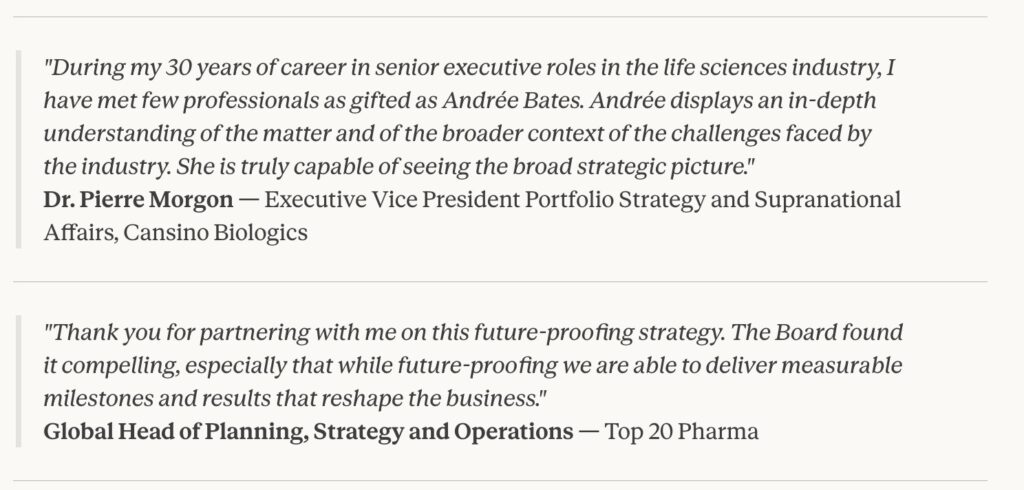
" Thank you for partnering with me on this future-proofing strategy. The Board found it compelling, especially that while future-proofing we are able to deliver measurable milestones and results that reshape the business. Thank you again. "
Global Head of Planning, Strategy and Operations, Top 20 Pharma [The client has requested anonymity in keeping with their internal communications policy — a request we always honour.]