

In 2026, 81% of physicians reported using AI for work, more than double the 38% the American Medical Association recorded in 2023. Yet AI adoption in healthcare and life sciences looks very different at the enterprise level. A Bain & Company and Mayfield Fund survey of 133 life sciences executives (Q4 2025) found that only 20% of organisations are scaling AI with measurable value; the rest remain trapped in pilots. People are eager on their own, but institutional trust is the real roadblock.
This is precisely where pharma AI resistance becomes revealing. The strongest pushback usually comes from top talent, not underperformers. Think of the senior chemist who has seen promising in silico breakthroughs fail in the lab, or the QA manager who has to face strict regulatory audits, the doctor whose professional reputation guides patient treatments, the field medical science liaison protecting hard-earned peer relationships, or the safety expert who truly grasps the grim cost of ignoring adverse drug reactions.
Their doubt isn’t just an obstacle to fix; it serves as vital risk intelligence. When mistakes impact patients, skeptics act as the ultimate safeguard. This piece explores the reasons behind top talent hesitation, validates their justified worries, and outlines a compliant strategy to bring them on board.
The AI Adoption Paradox – Why Pilots Stall Between the Boardroom and the Bench
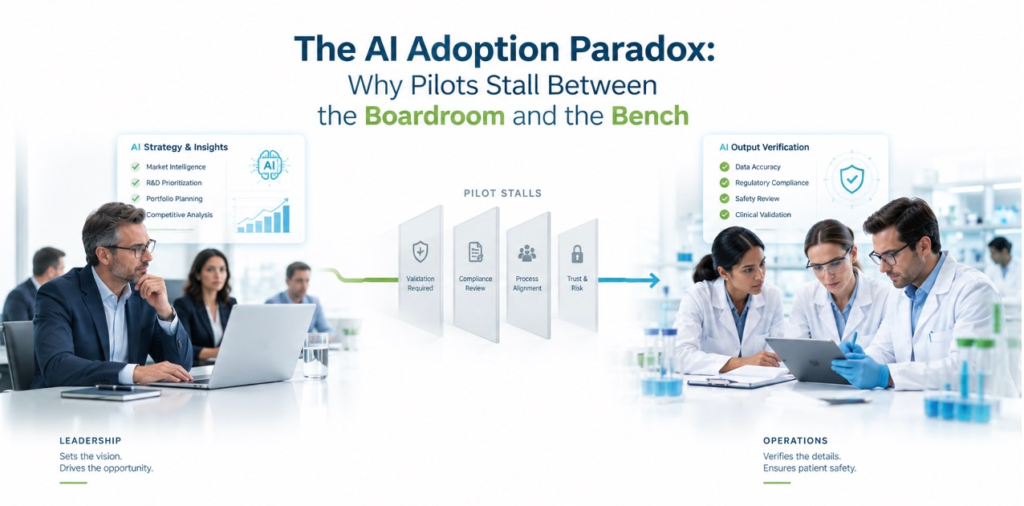
The adoption gap with AI often stems from how differently leaders and frontline staff interact with the technology. Leaders use it to brief and draft. Frontline staff have to verify its outputs, defend them and sign them off.
BCG’s AI at Work survey of more than 10,600 employees shows the divide: 85% of leaders use generative AI several times a week, compared with 51% of frontline employees, a figure that has stalled. Health care also lags on workflow redesign, at 41% against 54% in financial services and technology. That’s not simple conservatism. In pharma, changing a validated process triggers change control, revalidation and inspection risk.
BioPhorum’s benchmarking shows the result. Only 4 of 30 recorded use cases were live and embedded, all in quality, IT and data science functions. Real usage gathers around quiet, unglamorous tasks like handling compliance, managing deviations, and organizing documentation. Interestingly, none of those successful quality systems came straight off the shelf, because each one was custom-built internally or co-created alongside a vendor. AI only succeeds when domain experts actively participate in its creation.
The primary limitation remains fundamentally human. Bain identifies behavioral change and employee adoption as the single biggest hurdle for deployments. Meanwhile, the Pistoia Alliance notes that 34% of life science research groups struggle with a shortage of proper skills. This knowledge gap cuts in two directions, leaving scientists short on data fluency while data scientists lack specific domain understanding. Experts therefore double-check every automated output manually. Such caution is not meant to block progress, but rather serves as smart behavior when no one has clearly explained how a system might fail.
Technology isn’t the bottleneck. The real challenge is earning trust – the confidence that a program will act reliably, reveal its mistakes openly, and provide a clear, defensible audit trail. Winning that trust is always hardest among the most expert people, because they understand the potential risks better than anyone else.
The Psychology of Expertise – Why Top Performers Push Back Hardest

Expertise is more than a skill set. It’s an identity, built over years and confirmed by colleagues, regulators and patients. A radiologist who has spent twenty years learning to read scans, or a regulatory writer whose submissions rarely draw a query, has built their professional worth on judgement that once seemed impossible to automate.
When AI offers to do that work in seconds, it doesn’t feel like help. It feels like a challenge to the very thing that makes them valuable. BCG calls this group “Cautious Sceptics” – experienced, capable people who doubt AI’s reliability and worry about what it means for their expertise and professional identity.
Five drivers of expert resistance
● Identity threat. “If a model can do this, what am I for?” When competence is central to how someone sees themselves, automation can feel like a demotion rather than a time saver.
● Loss aversion and status quo bias. A validated method with a clean inspection record carries known risk. An unproven tool carries unknown risk. In GxP settings, preferring the known is often sound judgement, not just bias.
● High personal standards. Top performers spot AI errors sooner and forgive them less. A single invented reference or misclassified adverse event can end their trust in a tool for good.
● Loss of autonomy. Tools imposed from above feel like surveillance rather than support, especially when they log usage or score output. Experts want control over their methods because they carry the accountability.
● Earned scepticism. Many have lived through over-hyped EHR roll-outs that added hours of clerical work, CRM systems that field teams quietly abandoned, and “digital transformation” programmes that ended without delivering. Their doubts come from experience.
Treating all this as “change resistance” to be overcome backfires. Pressure tells experts their judgement isn’t wanted, so they check more, use less or work around the tool. A better approach is to treat expert scepticism as a design input.
Every objection points to a failure mode, an evidence gap or an accountability question that the deployment must answer before anyone can trust it. Answer those questions, and your toughest critics become the people who make AI safe.
Patient Safety, GxP and Accountability – When Resistance Is Professional Responsibility

In pharma and healthcare, the person who signs is the person who is accountable. Every batch release, safety signal assessment, clinical study report and prescribing decision traces back to a named person: a qualified person (QP), a safety physician, a medical writer or a prescriber. That person’s signature, and sometimes their professional registration, stands behind the decision.
If an AI tool can’t explain how it reached its output, asking that person to rely on it creates an accountability gap. The tool shapes the decision, but only the human takes the consequences. When experts refuse to sign what they can’t defend, they’re doing their job.
The regulatory concerns your experts are right to raise
● Model credibility. The FDA’s January 2025 draft guidance sets out a seven-step, risk-based credibility framework built on “context of use”. Model risk depends on how much the model’s output influences a decision and how serious the consequences of that decision are. Experts are right to ask what the tool is approved to do and what it is not.
● Joint regulator principles. In January 2026, the FDA and EMA jointly published the Guiding Principles of Good AI Practice in Drug Development. The 10 principles include following GxP standards, defining a clear context of use and applying oversight in proportion to risk. They are voluntary for now, but they show where regulators expect the industry to go.
● Data integrity. Can AI-generated content meet ALCOA+ standards: attributable, contemporaneous, original and complete? Does it leave an audit trail that will stand up to inspection?
● Hallucination risk. A fabricated citation in a medical information response, a regulatory document or a literature review is more than embarrassing. It can be a compliance failure.
● Human oversight duties. Article 14 of the EU AI Act requires effective human oversight of high-risk systems, and many healthcare applications fall into that category. Oversight only counts if the reviewer can actually understand the output and override it.
● Liability. If the AI gets it wrong, who answers for it: the clinician, the QP or the vendor? Most contracts and SOPs don’t yet give a clear answer.
The answer isn’t to ask experts to lower their standards. It’s to match the rigour of governance to the level of risk. Low-risk drafting tools need light controls. Tools that affect batch release, safety assessments or patient care need full validation, clear limits on use, and reviewers with the authority to reject the output.
The Deskilling Dilemma – A Fear Backed by Evidence

Fear of losing skills is not paranoia. A multicentre study in The Lancet Gastroenterology & Hepatology (2025) looked at 19 highly experienced endoscopists across four centres in Poland. Each had performed more than 2,000 colonoscopies, with an average of 27.6 years in practice.
After AI-assisted polyp detection was introduced, their adenoma detection rate in colonoscopies performed without AI fell from 28.4% to 22.4%. The study is observational, covers only three months on either side of the change and cannot prove cause. Even so, it gives real evidence for what many clinicians already sense: skills that stop being used start to fade, even among the most experienced.
What the data tells us
● Clinicians are worried. The AMA’s 2026 survey found that 88% of physicians have some concern about skill loss. Concern is highest among those with 10 years or less in practice, the people who are still building their judgement.
● Automation bias is real. People tend to over-trust confident machine outputs and gradually stop checking them independently. A fluent answer is easy to accept and hard to question.
● Pharma has direct parallels. Junior scientists may never learn to interpret raw assay data. Pharmacovigilance associates may end up triaging cases they couldn’t assess on their own. Medical writers may polish AI drafts but lose the ability to build an argument from the evidence themselves.
● The training pipeline is at risk. Juniors learn through routine work. If AI takes that work over, where will tomorrow’s QA leads, toxicologists and safety reviewers come from? And who will catch the model’s mistakes?
How to design against deskilling
● Run regular “AI-off” checks. Competency assessments and simulation drills, like a pilot’s manual flying hours, keep core skills sharp and give early warning of decline.
● Judge first, then compare. Staff record their own assessment before they see the AI’s output. That way the tool challenges their judgement instead of replacing it.
● Require transparent tools. AI tools should show their reasoning, sources and confidence, not just an answer. Experts learn from tools they can question. Their skills fade with tools they can only accept.
Trust, Job Security and the Leadership Gap
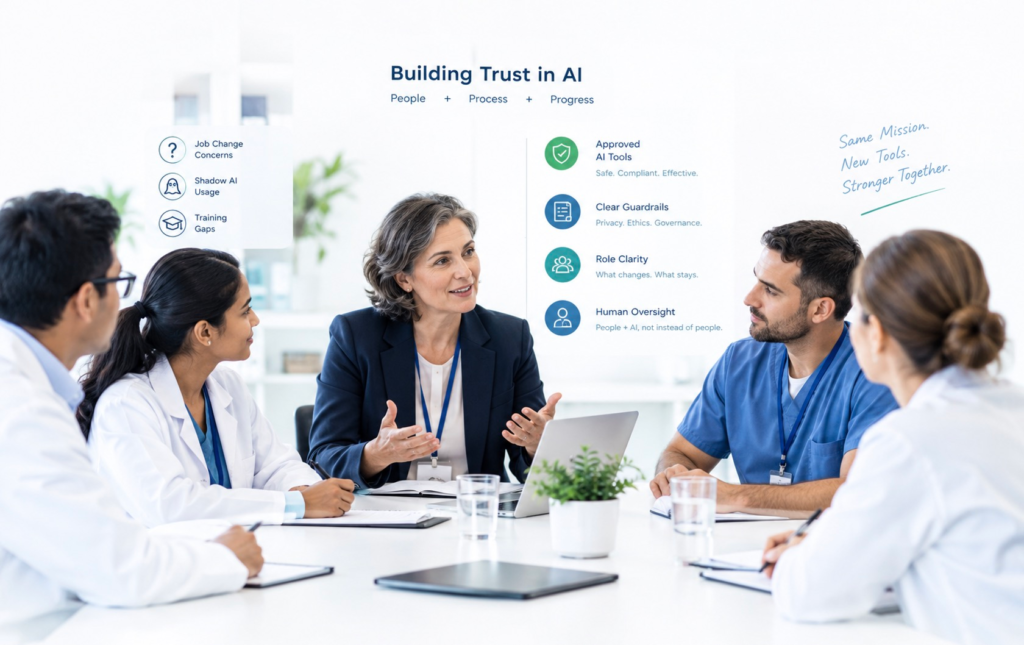
Trust in AI is fragile, and it often drops once people start using the tools in their real work. Deloitte’s TrustID Index tracks employee sentiment daily. Between May and July 2025, it found that trust in company-provided generative AI fell by 31%, and trust in agentic AI fell by 89%.
Agentic AI means systems that act on their own rather than just make recommendations. Employees grew uneasy as these tools began taking over decisions that used to be theirs. Job insecurity adds to the problem. BCG found that 46% of employees in organisations going through comprehensive AI-driven redesign worry about job security, compared with 34% elsewhere. The more ambitious the change, the more anxious people get.
The leadership gap in numbers (BCG, 2025)
● Too little guidance. Only 25% of frontline employees say their leaders give them enough guidance on AI.
● Leadership makes a real difference. With strong leadership support, the share of employees who feel positive about AI rises from 15% to 55%. Few other factors have that much effect.
● Training falls short. Only about one-third of employees say they’ve been properly trained. Regular use rises sharply among those who get at least five hours of training, plus in-person coaching.
● Shadow AI fills the gap. 54% say they would use AI tools even if they weren’t authorised. In a GxP setting, unapproved tools threaten data integrity, patient confidentiality and inspection readiness.
Messages that rebuild trust
● Be honest about how roles will change. Vague reassurance like “no one will lose their job” breaks down at the first restructuring. Tell people which tasks will change, which will stay and how support will work.
● Say what AI will never decide on its own. For example, patient care, batch release or causality in safety cases. Clear limits make every other use easier to accept.
● Reinvest the time saved. Commit publicly to putting saved hours into higher-value scientific and patient-facing work, not just cutting headcount, and show where that time went.
The Playbook: Seven Ways to Bring Your Best People With You
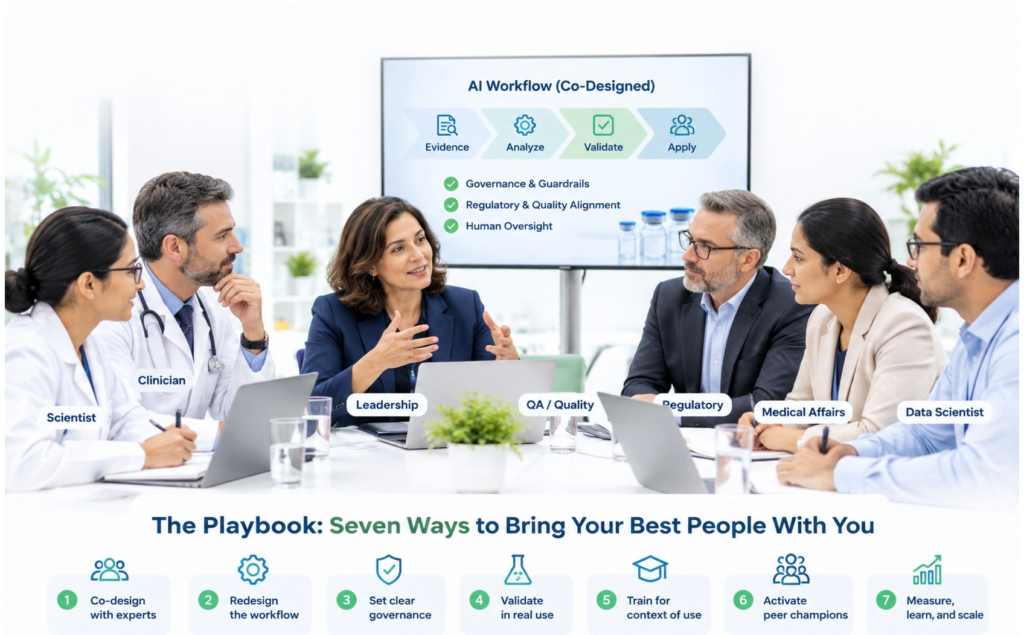
Adoption works when it’s built with experts, not done to them. Columbia Business School and the BCG Henderson Institute surveyed about 1,400 US employees and leaders. They found that employee centricity was the biggest single factor in AI maturity, ahead of industry, department and company size. Employee-centric organisations were around seven times more likely to be AI-mature than those at an early stage. Experts also want a say: in the AMA’s 2026 survey, 85% of physicians wanted to be consulted on, or directly involved in, decisions about adopting AI.
The playbook
1. Involve experts from day one. Put sceptical experts on the panels that choose and validate use cases. Give them real decision rights, including the power to stop a deployment. A seat with no real say only makes people more cynical.
2. Start with the pain, not the platform. Target the work experts dislike: drafting SOPs, reviewing audit trails, screening literature and writing clinical documentation. The AMA found that 80% of physicians see AI as a way to automate tasks that drive burnout. Early wins on tedious work earn credibility for harder use cases.
3. Define the context of use clearly. Follow the FDA’s approach. For each tool, write down what it does, what it doesn’t do, what data it uses and who checks the output. Clear limits make a tool easier to trust.
4. Invest seriously in training. BCG found that regular use rises sharply among employees who get at least five hours of training plus in-person coaching. AI literacy is also a legal duty. Article 4 of the EU AI Act has applied since 2 February 2025, and the Digital Omnibus (Regulation (EU) 2026/1744), in force from 27 July 2026, reframed it as an ongoing obligation to take measures that support staff AI literacy. National regulators began supervising it in August 2026, so a one-off workshop is harder to defend than continuous, role-specific training.
5. Build tiered credentials. AstraZeneca has certified more than 17,000 employees through a Bronze–Silver–Gold framework. This makes AI skill part of career progression instead of a threat to it.
6. Use peer champions, not mandates. Picture a respected senior scientist showing colleagues how they use a tool and where they don’t trust it. That persuades people far more than a vendor demo.
7. Redesign workflows, not just tools. Adding AI to broken processes gives disappointing results and proves the sceptics right. Map the process from start to finish and remove steps that aren’t needed. Then decide where AI adds value and where human review belongs.
Each step puts scepticism to work. Experts’ objections shape which use cases get chosen. Their standards set the validation criteria. Their credibility drives adoption. When your toughest critics help build the system, they have a stake in making it work.
Tailoring Adoption Across the Pharma and Healthcare Value Chain

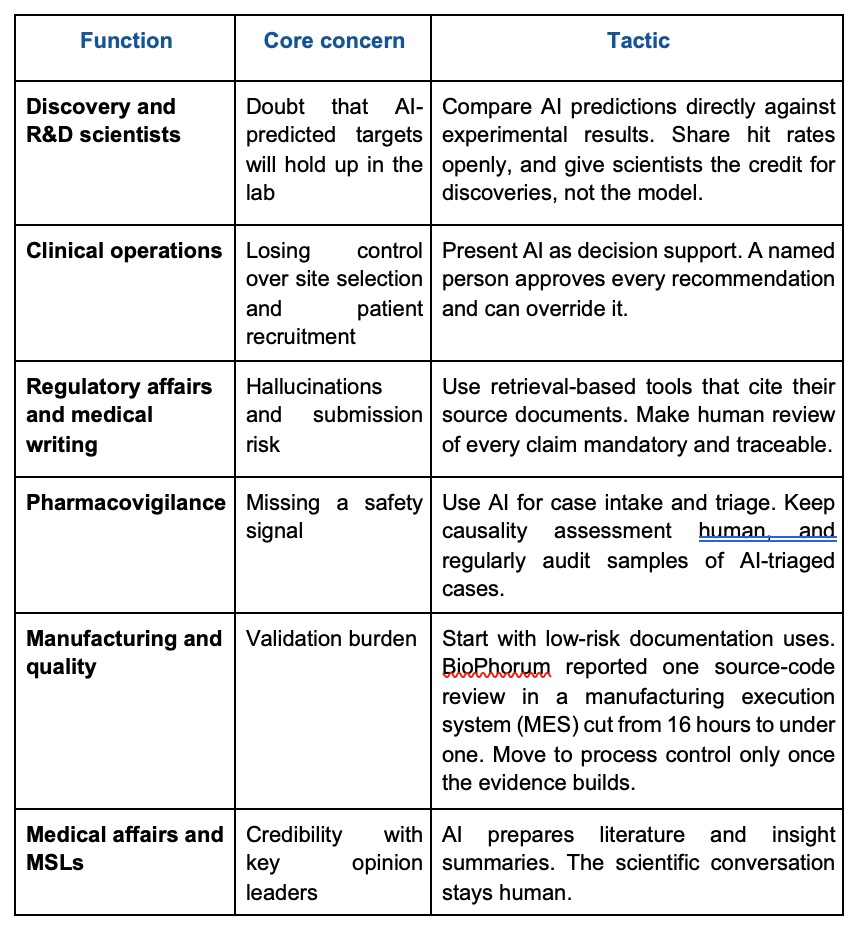
Resistance looks different in each function, so one change programme for everyone won’t work. A discovery scientist worries that the biology is wrong. A safety physician worries about missing a signal.
Each concern is specific and needs a specific answer. Leaders need tactics that fit each group’s risks, workflows and professional identity.
Function-by-function guidance
What this means for leaders
● Match the tactic to the risk. Start with low-risk documentation, then move to decision support. Go near patient-critical decisions only after that.
● Let each function set its own acceptance criteria. A QA lead and a medical writer define “good enough” differently. Both are right for their own work.
● Share wins across functions. A quality team’s proven time savings will persuade R&D sceptics more than any strategy deck.
From Resistance to Stewardship: Turning Sceptics Into Your AI Governors
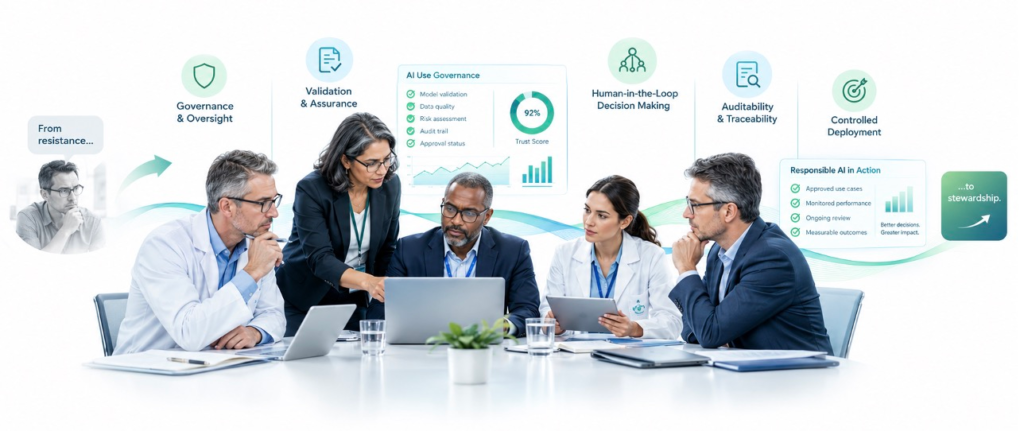
The most important change is strategic. Your most critical experts are the people best placed to govern AI. They know where processes break, which errors matter and what an inspector will ask. Make them validators, “human-in-the-loop” leads and permanent members of AI governance boards and centres of excellence. Give them formal authority and protected time, and recognise the role in their careers. Then their scrutiny stops being a brake on adoption and becomes its quality system.
Success also needs measuring differently. Login counts and licence numbers show activity, not value. Leaders should track trust scores over time and how often experts override AI outputs. A falling override rate can mean the tool is improving or that reviewers have stopped checking, so read it alongside error interception: how many AI mistakes were caught before they reached a submission, a batch record or a patient. Add retained competence from “AI-off” assessments and the time returned to scientific and patient-facing work. Together, these show whether AI is making the organisation better or just busier.
Looking ahead, oversight will matter more. KPMG’s US pulse survey of large organisations across all sectors found that deployment of AI agents rose from 11% in early 2025 to 54% a year later. As agents move from drafting to acting, the need for expert human judgement will grow, not shrink.
Organisations that honour expertise will build AI that regulators, clinicians and patients can trust. In a sector built on evidence and accountability, that trust is a lasting competitive advantage.

Conclusion
When your best people resist AI, it isn’t a failure of change management. It’s a signal worth listening to. Their pushback comes from four causes: a threat to professional identity, accountability gaps they would have to sign for, real evidence of deskilling, and trust worn down by hype and job insecurity. Each has a remedy.
Design tools with experts from the start. Define each tool’s context of use clearly. Invest seriously in training. Lead visibly, and be honest about how roles will change. In pharma and healthcare, the goal isn’t AI that replaces judgement. It’s AI that makes good people better, so patients get safer, faster and more human care. Start this quarter: identify your three most sceptical experts and give them a seat at the AI design table. They’ll tell you what will break, and then help you fix it.
Expertise is your strongest AI asset, if you build on it
Your most sceptical experts already know where AI will fail.
The Pharma AI Enablement Institute,
led by Dr Andree Bates, turns that judgement into a standard each function can apply.
It does this through pharma role-specific training (from discovery right through to commercial across all the value chain and enabling functions), a shared approach for judging whether AI output is fit for regulated use, and a curriculum kept current as the tools and regulations change.
For more information, contact Dr Andree Bates abates@eularis.com.