
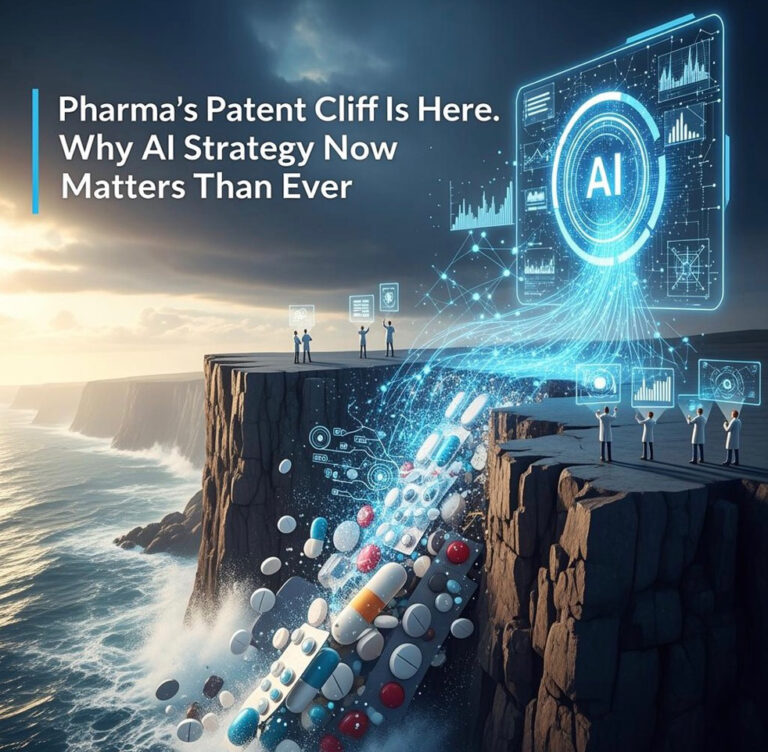
The pharmaceutical industry is entering a decisive period. Over the next several years, many of its most valuable brands will lose exclusivity, putting a substantial share of industry revenue under pressure. This is not simply a lifecycle management issue. It is a strategic test of how well companies can protect existing value, replace declining revenue, and make better decisions under increasing competitive and organisational strain.
That is why the patent cliff and AI strategy now need to be considered together.
Too often, these conversations remain separate. Patent expiry is treated as a portfolio issue. AI is discussed as a technology agenda. In practice, the two are now deeply linked. The companies that navigate the coming years most effectively will not be those with the most AI pilots or the broadest digital rhetoric. They will be those who apply AI with strategic discipline to the decisions that matter most.
With best-selling brands representing $173.9 billion in annual sales at risk by 2032, and broader estimates putting the total exposed revenue at $200 billion to $350 billion, the scale of the challenge is unmistakable. Through 2030 alone, annual revenue at risk is estimated at more than $200 billion. These are not peripheral products. They are foundational brands that have shaped company growth, funded pipeline investment, and supported market leadership.
The implications are clear. This is not a narrow IP event. It is a test of revenue resilience, capital allocation, portfolio quality, launch readiness, market access strength, and enterprise execution.
This Patent Cliff Is Structurally Different
What makes this cycle especially important is that it is not defined by a single erosion pattern.
For small molecules, the traditional dynamics still apply. Once generics enter, revenue can fall sharply, with market loss reaching roughly 80% within 30 to 90 days. In these cases, the challenge is immediate and severe. Value disappears quickly, and the room for commercial maneuver narrows fast.
But much of the current cliff also involves biologics, where the dynamics are more complex. Biosimilar erosion is often slower, less linear, and more dependent on physician behavior, payer decisions, contracting, interchangeability, and treatment pathway realities. This does not make the threat smaller. It makes it more strategic. Share erosion may be delayed, contested, or uneven, but it still has the potential to be highly consequential.
That distinction matters because it changes where AI can create value.
For small-molecule exposure, AI is most powerful when it supports speed, prioritisation, resource allocation, and operational efficiency. For biologics, the more valuable role may be in payer strategy, account targeting, field-force precision, evidence planning, and identifying where share can still be defended.
The point is simple: there is no generic AI response to the patent cliff. The response must be aligned with the nature of the exposure.
2026 Already Makes the Challenge Immediate
This is not a distant issue. The 2026 U.S. loss-of-exclusivity wave alone shows how operational the pressure already is.
Several important brands are approaching or entering competitive vulnerability, including:
2025–2026 Expirations
● Eliquis (apixaban), with $13+ billion in 2024 BMS-reported sales, with generics already FDA-approved
● Farxiga (dapagliflozin), with $7.7 billion in 2024 global sales; primary molecule patent expired October 2025, with secondary patents extending into the late 2020s
● Prevnar family (pneumococcal vaccines), with $6.41 billion in 2024 global sales
● Cosentyx (secukinumab), with $6.14 billion in 2024 global sales
● Revlimid (lenalidomide), with $5.77 billion in 2024 global sales despite ongoing generic competition
● Shingrix (shingles vaccine), with $4.30 billion in 2024 global sales
● Xolair, with $3.7 billion in 2025 U.S. sales
● Pomalyst, with $2.34 billion
● Bridion (sugammadex), with $1.76 billion in 2024 global sales; primary patent expired January 2026
● Opsumit, with $1.63 billion and 10 approved generic competitors
● Januvia/Janumet, with $1.27 billion and settlements involving 25 generic companies
● Simponi, with $1.19 billion
● Mavenclad, Gattex, Trintellix, Briviact, and Xeljanz, each adding further pressure across therapeutic areas
2027 Expirations
● Ocrevus (ocrelizumab), with $7.6 billion in 2024 global sales
● Ibrance (palbociclib), with $6.39 billion in 2024 global sales
● Xtandi (enzalutamide), with $5.98 billion in 2024 global sales —
● Eylea (aflibercept), with $5.97 billion in 2024 combined U.S. sales including Eylea HD
● Trulicity (dulaglutide), with $5.25 billion in 2024 global sales
● Ofev (nintedanib), with $4.07 billion in 2024 global sales
● Jakafi/Jakavi (ruxolitinib), with approximately $2.8 billion in 2024 global sales
● Lynparza (olaparib), with $1.31 billion in 2024 Merck alliance revenue
● Lenvima (lenvatinib), with $1.01 billion in 2024 Merck alliance revenue
2028 Expirations
● Keytruda (pembrolizumab), with $29.5 billion in 2024 global sales
● Opdivo (nivolumab), with $9.30 billion in 2024 global sales
● Gardasil/Gardasil 9 (HPV vaccine), with $8.58 billion in 2024 global sales
● Enbrel (etanercept), with $5.39 billion in 2024 global sales
2029 Expirations
● Jardiance (empagliflozin) family, with $13.01 billion in combined 2024 global sales (Boehringer Ingelheim + Eli Lilly)
● Darzalex (daratumumab), with $11.67 billion in 2024 global sales
● Repatha (evolocumab), with $3.57 billion in 2024 global sales
● Genvoya (elvitegravir combination), with $2.50 billion in 2024 global sales
Some of these products will face rapid generic erosion. Others may see slower but still meaningful biosimilar or competitive pressure depending on litigation outcomes, launch timing, manufacturing readiness, and payer dynamics. But that uncertainty should not obscure the underlying point: the cliff is not approaching. It is already shaping strategic reality.
For executive teams, this changes the nature of the AI conversation. The issue is no longer whether AI has potential. The issue is whether AI is being applied to the handful of decisions that will materially affect revenue protection and replacement over the next three to five years.
The Industry Response Has Begun, But Assets Alone Will Not Solve It
The sector’s response is already visible. Companies are turning to company-wide layoffs, restructuring, acquisitions, licensing, lifecycle strategies, and portfolio restructuring to rebuild future growth. Roughly half of blockbuster drugs approved between 2014 and 2023 were acquired rather than internally developed, and large pharmaceutical companies are estimated to have around $500 billion available for acquisitions and pipeline deals.
This is rational. When major revenue streams are nearing expiry, external innovation becomes one of the fastest ways to replenish a pipeline. But acquisition alone does not resolve the deeper strategic challenge.
Buying assets does not guarantee strong launch execution. It does not ensure better market access. It does not fix weak prioritisation, fragmented evidence planning, or poor commercial coordination. And it certainly does not ensure that AI efforts across the organisation are aligned to enterprise value.
That is where many companies remain exposed. They may be active in AI, but activity is not the same as strategic readiness.
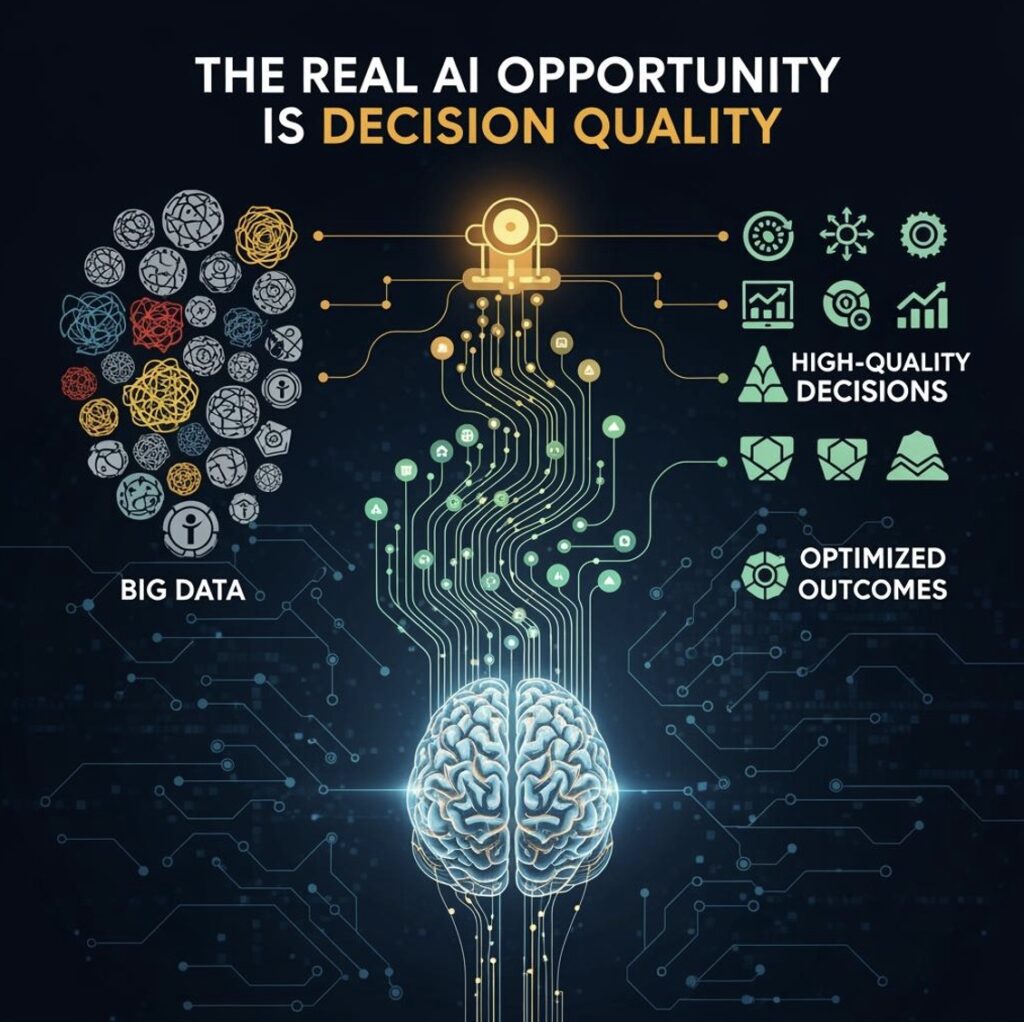
The Real AI Opportunity Is Decision Quality
The most common error in pharma’s AI agenda is to focus on use cases before clarifying the decisions that matter most.
The better question is not, “Where can we deploy AI?” It is, “Which decisions most influence our ability to protect value, replace revenue, and compete more effectively through the patent cliff?”
That reframing immediately sharpens the agenda.
First, AI can strengthen in-line brand defence. Before exclusivity ends, every quarter of retained performance matters. Better targeting, next-best-action, promotional precision, account prioritisation, and field-force deployment can materially affect value retention, particularly for biologics where erosion is slower and still contestable.
Second, AI can improve portfolio and pipeline prioritisation. When hundreds of billions of revenue are at risk, the cost of backing the wrong assets rises sharply. AI can help leadership teams assess signals earlier, synthesise competitive intelligence more effectively, and evaluate which opportunities are most likely to generate meaningful and timely replacement revenue.
Third, AI can enhance launch readiness and growth execution. Replacement revenue does not come from asset ownership alone. It stems from an effective launch into increasingly crowded markets. In obesity and metabolic disease, for example, there are now more than 120 assets in development across around 60 companies. In such categories, strategic precision can be as important as scientific promise.
Fourth, AI can improve market access strategy, an area still underappreciated in many AI programmes. In a world of biosimilar complexity and payer scrutiny, access is central to value capture. AI can help identify access risks earlier, support evidence planning, improve segmentation, and strengthen account-level strategy.
Finally, AI can drive enterprise productivity in functions that will come under increasing margin pressure. As exclusivity losses intensify, productivity improvements across medical, analytics, operations, and commercial support become financially more important, not less.
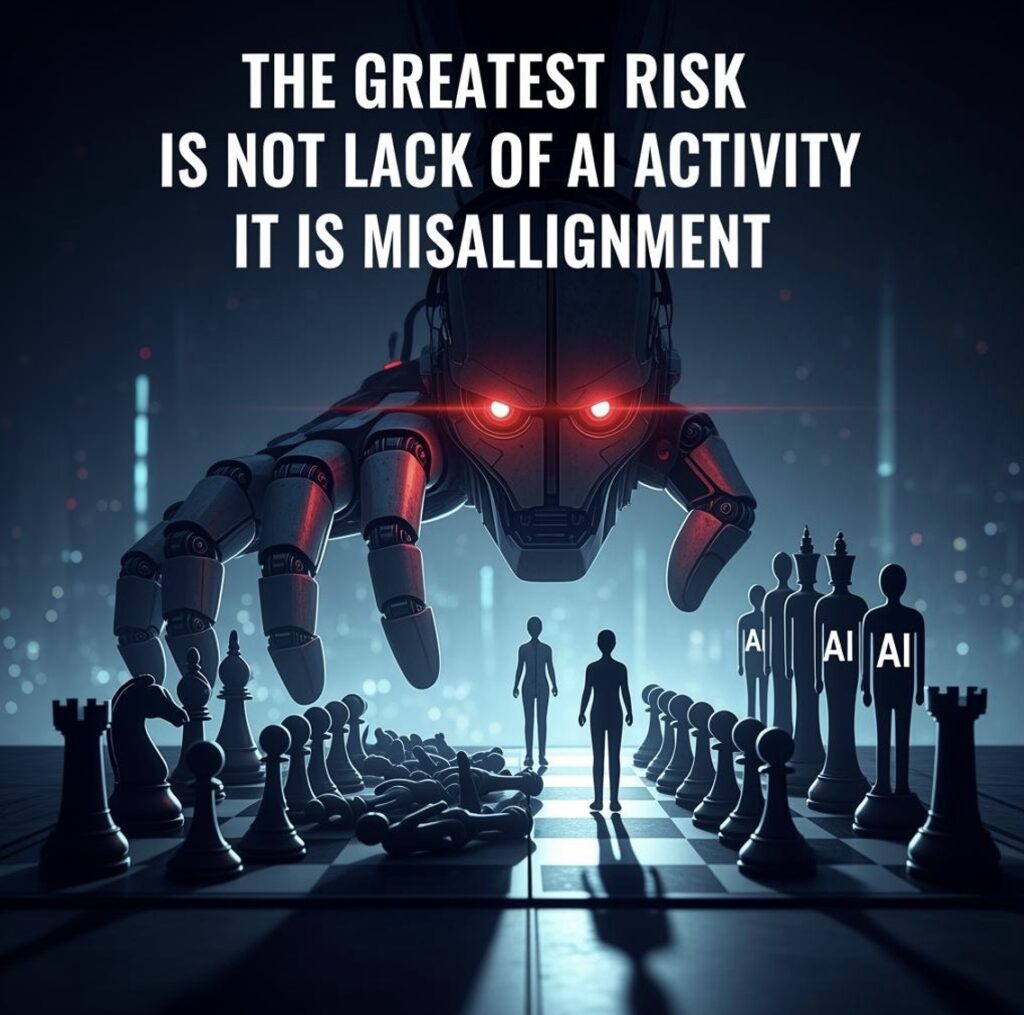
The Greatest Risk Is Not Lack of AI Activity. It Is Misalignment
Most large pharmaceutical organisations already have meaningful AI activity underway. What many still lack is a coherent link between that activity and the strategic realities of the business.
That is the real risk.
Too many companies still have:
● multiple pilots with no clear prioritisation;
● commercial AI disconnected from exclusivity-loss defence;
● R&D and business development AI are disconnected from revenue replacement priorities;
● insufficient focus on market access;
● generic governance that does not reflect pharmaceutical operating realities;
● success metrics based on experimentation rather than business impact.
In that environment, more AI investment does not necessarily create more value. It can simply create more fragmentation.
The companies that will outperform are unlikely to be those doing the most. They will be those making the clearest choices: where AI matters, where it does not, and how it must be governed and scaled to support enterprise priorities.
What Executive Teams Should Prioritise Now
Leadership teams should first quantify where revenue exposure is concentrated by brand, market, geography, and timing. They should then identify the decisions most likely to influence value protection or replacement, whether in portfolio prioritisation, launch sequencing, market access, evidence generation, targeting, or operating efficiency.
From there, current AI activity should be assessed against business value. Some initiatives will deserve acceleration. Others will need to be redesigned. Some should stop altogether.
Most importantly, companies need a cross-functional blueprint. The patent cliff is not a commercial issue alone, nor an R&D issue alone. It cuts across R&D, medical, market access, commercial operations, and enterprise strategy. The AI response must do the same.
What the Next 120 Days Should Look Like
A disciplined response does not begin with more pilots. It begins with sharper choices.
In the first 30 days, leadership teams should quantify revenue exposure, segment it by erosion profile, and identify the decisions that will most affect defence and replacement.
Within 60 days, current AI initiatives should be mapped against those decisions, with low-relevance efforts deprioritised and high-value opportunities prioritised across brand defence, market access, launch execution, and portfolio strategy.
By 90 days, the organisation should have a strong prioritisation matrix of AI activity with revenue impact by activity.
By 120 days, the organisation should have a cross-functional AI blueprint, clear business-impact metrics, and named leadership accountability for execution.
A Practical Test for Executive Teams
For leadership teams, the most useful question is not whether the organisation is “doing AI.” It is whether AI is improving the decisions that will matter most as exclusivity losses accelerate.
A practical test is whether the organisation can answer the following with clarity:
● Where, specifically, is revenue most exposed by brand, geography, and timing?
● Which losses are likely to follow rapid generic erosion, and which will depend on more complex biosimilar dynamics?
● Which in-line brands remain strategically defendable?
● Which 5 to 10 decisions will have the greatest effect on value protection and revenue replacement?
● Which AI initiatives are directly linked to those decisions?
● Which AI activities should be accelerated, redesigned, or stopped?
● Is market access sufficiently represented in the AI agenda?
● Are AI efforts across commercial, medical, R&D, and business development aligned to the same growth logic?
● Are outcomes measured in business impact or simply in pilot activity and experimentation?
If these questions cannot be answered clearly, then the challenge is not a lack of AI activity. It is a lack of strategic alignment
Conclusion
The Leadership Challenge Is Now Unmistakable
The pharmaceutical industry is moving into a period in which revenue durability can no longer be assumed. The scale of the patent cliff is too large, the competitive dynamics too complex, and the margin for strategic drift too small.
This is precisely why AI now matters at the leadership level. Not as a technology narrative, but as a decision capability.
The companies that emerge strongest will not be those with the most expansive AI agenda. They will be those who use AI to improve the decisions that determine whether value is defended, replaced, or lost.
That is the real strategic test now facing pharma.
Found this article interesting?
If you’re a pharmaceutical or biotech leader, there’s a good chance you’re sitting with something uncomfortable right now.
You have AI activity. You might even have significant AI investment. But when someone at board level asks you what it’s all going to deliver — and when — the honest answer is murkier than it should be. You have initiatives, but you’re not sure you have a strategy. And somewhere in the back of your mind, you know those are very different things.
That gap — between the AI activity in your organisation and the clarity, alignment, and measurable return that should follow it — is exactly what we exist to close.
At Eularis, this is the work we do. We’ve spent more than two decades building AI for pharma, which we still do, and more than a decade building AI strategies for pharmaceutical and life sciences organisations — not tech companies, not retail, not financial services. Pharma and Life Sciences. The regulatory complexity, the data challenges, the organisational dynamics, the board expectations. We know this environment because we’ve never worked in any other.
Depending on where your organisation is right now, that work takes different forms.
The simplest starting point is a 45-minute AI Strategy Diagnostic. It’s a focused conversation — your specific situation, your specific gaps, an honest read on what needs to happen first. No frameworks applied from the outside in. Several of the organisations we work with most closely today started exactly there.
Just drop us an email at contact@eularis.com or go to the contact us form on the website.