

In the past few years, almost 70% of biopharma companies have initiated AI initiatives. Yet, fewer than 20% report a cohesive AI strategy at the enterprise level, according to Deloitte’s 2024 Life Sciences AI Survey. It’s not the lack of technology that is really causing the divide – it’s a lack of strategic alignment.
That cost doesn’t appear on quarterly earnings; it hides in disconnected data ecosystems, slower clinical cycles, and strategic blind spots where insights should be. In an industry in which one wrong turn could add months to regulatory timelines or derail patient access, the absence of an AI strategy weakens competitiveness even if nobody hears it fall.
The real threat is not being behind on adoption – it’s the inability to orchestrate AI as a smart layer of decision making, culture, and trust. In the modern pharma environment, those without an AI strategy aren’t just outdated, they’re actively trading on yesterday’s model.
The Misconception: We’re Fine Without AI Apart from Co-Pilot (For Now)
Many pharma leaders are comforted by the assumption that waiting to go big on AI is a wise move – prompted by wariness, regulatory complexity, or persistent fatigue from digital transformation initiatives underway. But this “wait-and-see” stance masks a much deeper vulnerability.
Within these same enterprises, shadow adoption is on the rise – scientists feed confidential molecule data to public GenAI sites for analysis, marketers draft medical content using unsecured tools, analysts run experiments with unvetted models, each incident a slow but steady corrosion of data integrity, compliance, and control.
In the meantime, competitors are not waiting; they’re compounding advantage through micro-transformations – automating literature triage, shortening preclinical models, and enriching pharmacovigilance insights. These incremental, AI-powered marginal gains add up to a systemic advantage that’s hard to chase once it’s established.
The spoiler, then, is driving: the actual threat arrives well before we reach a stage of widespread AI deployment. It comes from strategic inertia, where lack of direction poses as prudence, while in fact it hardens culture, fragments experimentation, and leaves an organization intellectually unprepared for the next wave of data-driven competition.

The Hidden Costs Explained
The opportunity cost of not having a full-fledged AI plan is much more than just technological hurdles – it goes into the heart of strategic decision-making and business process efficiency.
Without a clear strategic AI blueprint, strategic blind spots emerge – the experimentation only happens in isolated silos, but not as part of a unified innovation canvas. Managers lose sight of what will actually be automatable, which areas deliver short-term versus long-term ROI, and how ready they are overall based on data maturity – leaving decisions to be made with hype trend instead of insight and strategy.
At the same time, without well-designed AI governance there is data decay and missed opportunities to build infrastructure – when quality checks and solid labelling does not exist with governance standards in place¸ companies then often say this: “We already have enough problems we can’t seem to conquer today so if we were going to do something with AI it’s too late as we would discover that for years our existing data was actually garbage,” making a post-hoc transformation 10X more expensive (both dollar heavy and time brittle) than addressing these issues way before they decided.
This wilful inattention only compounds the cultural divide; teams without a clearly defined AI framework can become resistant, afraid of, or disjointed in their approach to innovation, equating these feelings with a lesser experimentation appetite, a lack of cross-functional collaboration that leads to an inability to work well together, and seeing AI as an attack rather than an ally in progress.
And the demand for top AI talent and even ambitious cross-domain thinkers means there are more opportunities than ever for these influential engines to jump ship, leaving slower-moving companies with worse experts who will contribute in lesser ways to projects, and a high turnover rate, along with significant loss of intellectual capital.
And, lastly, this strategic negligence exposes organizations to compliance and ethical risks; rogue, unregulated shadow AI initiatives bring with them potential for breaches, IP risk leaks, and ethical hardships.
While governments are rolling out (and tightening) regulation in the AI space – through initiatives like the EU AI Act and an increasingly assertive FTC, for example – the cost of ad hoc reaction to a breach is exponentially higher than a proactive investment in ethical governance.
Together, these invisible expenses are a reminder that without a comprehensive, enterprise-wide strategy for AI, the pharmaceutical industry is at risk of more than immediate operational inefficiencies – it’s also likely to lead to intelligence and competitiveness through leveraged resilience depletion over time.
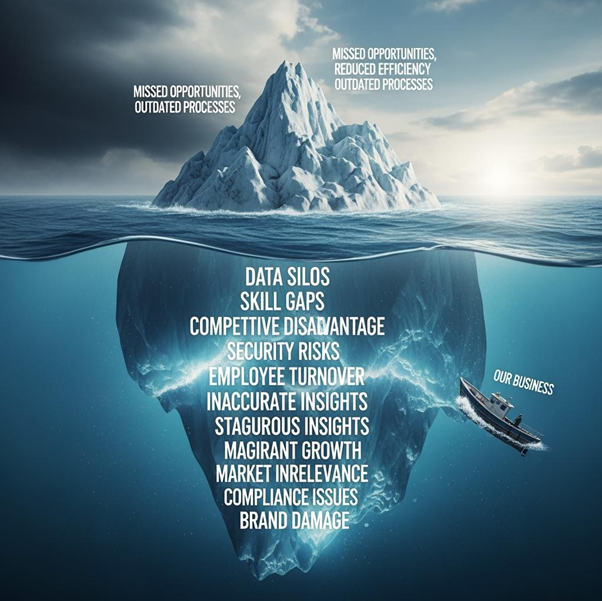
The Long Game – Opportunity Costs
Without AI integrated down into fundamental decision-making systems, firms are working with “delayed learning loops”, i.e., the insight cycles that drive clinical optimization, patient stratification, and go/no-go market feedback are constantly are forever delayed. Every iterative delay – from trial design to the generation of real-world evidence – widens the intelligence gap against the faster learning rivals. This pattern of compound lag means months, even years of lost innovation velocity.
Behind the walls of internal delays, a lack of digital maturity results in ecosystem exclusion – strategic partners, tech collaborators, and data vendors are more likely to pick AI-ready enterprises that can plug into automated workflows and secure data exchanges. Pharma partnerships are moving toward interconnected digital ecosystems and the free flow of information, from which companies that lack AI capacity have been locked out, where the next breakthroughs originate.
Meanwhile, competitive asymmetry becomes unavoidable. Their models grow exponentially wiser, building up both predictive power and accuracy as data and algorithms co-evolve. On the other hand, organizations following a linear strategy – processing static data based on manual patterns from data suffer from declining strategic benefit. In an exponential economy, staying in the same place is actually losing ground: each learning cycle missed is compounded by the advantage held by those who are constantly training their systems, insights, and people.
AI readiness, then, is not just about adopting technology but also building evolutionary capacity over the long game. Those who don’t play it will notice that irrelevance doesn’t come suddenly; it sneaks up through the cracks, one unabsorbed iteration at a time.
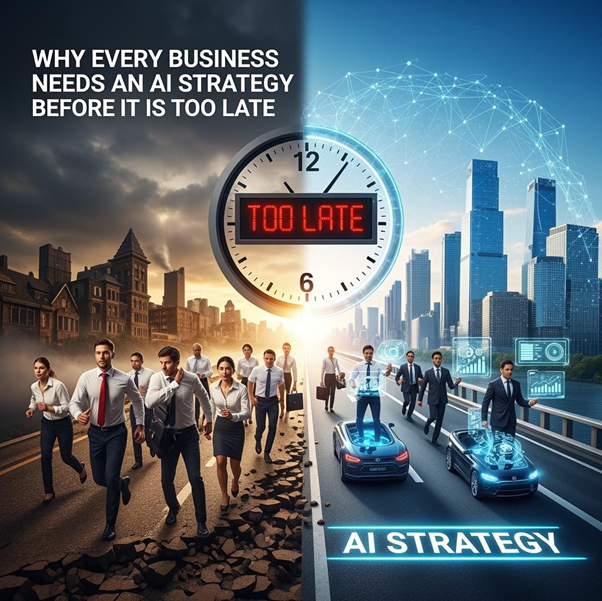
The Strategic Shift from “AI Tools” to “AI Embedded”
The shift from tactical adoption of AI to strategic transformation with AI starts with a change in mindset. Many organizations treat AI today as a purchasing decision, as a process of selecting vendors, widgets, or automation platforms. But at the most high-performing biopharma companies, AI isn’t a toolkit; it’s a philosophy of embedding human augmentation – a disciplined approach to redefining how human intelligence, machine learning, and decision-making come together.
The question changes from “What AI tool should we buy?” to “How will AI scale up our scientists, clinicians, and strategists to think better, decide faster, and innovate deeper?” This reframing of the challenge recognizes that technology is ephemeral, but the organizational ability to learn with AI is permanent. The leaders who manage to make this transition are also the ones who cultivate companies where experimentation, ethics, and data stewardship are no longer one-off initiatives but part of the very DNA of the corporation.
A) Vision Alignment: Strategy Before Software
The right approach to AI starts with vision alignment – fusing the use of AI with your business’s mission, rather than opportunistic pilots. In pharma, this equates to the following: How can AI speed up our board and business units meeting their financial goals while serving our patients and people best?
Without this alignment, investments in AI splinter across departments, yielding isolated wins with no additive lift. The most forward-thinking of these are articulating a north star that links AI capabilities directly to strategic goals – be they accelerating personalized medicine, optimizing supply chains, or tackling trial attrition. In other words, AI strategy is a function of corporate purpose, not circumstantial convenience.”
B) Data Readiness: Laying the Foundation for Intelligence
AI models are not inherently intelligent – they’re only as smart as the data ecosystems on which they feed. But most pharma companies are still working with fragmented, siloed data that is not compatible with adaptive learning systems. Mature AI philosophy, in other words, insists on data preparedness -the mindful auditing, cleaning, formatting, and fusing of information from different domains. It is about constructing interoperable infrastructures that link R&D data to clinical, manufacturing, and commercial datasets under a common governance system. As Deloitte’s Generative AI in Healthcare study suggests, the companies achieving sustainable ROI are those that ease into large-scale AI rollouts with end-to-end data modernisation investments. A clean, well-labelled, and ethically managed data foundation is no longer an IT detail; it is the neurologic substrate of competitive advantage.
C) Financial Modelling Framework: Prioritizing AI Investments
Rigorous financial analysis is the foundation of sound AI strategy; enthusiasm for innovation should never outpace disciplined assessment of business value. A robust financial modelling framework enables organizations to evaluate, compare, and prioritize generative and predictive AI initiatives based on their projected return on investment before committing significant resources. This should only be done after the strategy has examined data availability and likely cost and return. Eularis always do these in our strategic AI blueprints as our 20+ years of expertise in building AI for Life Sciences and our ROI analysis of each project, gives us unparallel insight into anticipated returns. Without that insight, it is difficult to get your financial model right on the data and build part.
This model then requires building standardized business cases that quantify expected value across three dimensions: revenue gain (new products, faster time-to-market, enhanced customer acquisition), efficiency gain (reduced operational costs, accelerated processes, decreased manual effort), and quality gain (improved accuracy, reduced errors, better outcomes). Cross-functional teams – comprising finance analysts, domain experts, and technical leads – should collaborate to develop realistic projections with clearly stated assumptions. By institutionalizing financial discipline, organizations move from pursuing scattered pilots to maintaining a ranked portfolio of AI opportunities where capital flows toward initiatives with the strongest validated business cases. Crucially, these frameworks must include post-deployment measurement against projected returns, creating accountability loops that refine future forecasting accuracy and ensure AI investments genuinely deliver organizational value.
D) Governance: An Enabler Rather than a Constraint Ethics
In the post-regulatory world in which the EU AI Act (and equivalent regulatory frameworks around the world) will bring about, governance can no longer be an afterthought; it must be a strategic facilitator. Ethical AI use in pharma cuts through all the layers: algorithmic bias in patient matching, data privacy compliance across multi-country trials, and transparency across automated decision systems. For the most forward-thinking companies, governance is not just a compliance check box but a design principle – in which every model and AI process undergoes an ethical review and risk evaluation from the start.
A trustworthy AI framework supports that governance early on improves scalability when the system is auditable, explainable, and universally trusted. Ethical design isn’t bureaucracy – it’s the rails on which sustained innovation delivers in a regulated industry based on public trust.
E) Upskilling Plan From AI Literacy to AI Fluency
The last pillar of an AI philosophy is upskilling – building a workforce that not only uses AI but also thinks with it. The future leaders of pharma will be scientific generalists who are as comfortable with biology as they are with algorithms, and easily interpret model outputs and apply those insights in clinical and commercial applications.
Upskilling should necessarily combine technical training with ethical reasoning, critical assessment of model limitations, and joint problem-solving between humans and machines.
Teams taught to collaborate with AI, instead of against it, become a force multiplier – boosting enterprise productivity, busting silos, and inculcating a culture where AI is no longer an external disrupter but instead becomes the internal enabler of human capability.

Value Framework: Measuring the Cost of “No Strategy”
For the pharmaceutical and life sciences industry, a lack of AI strategy does not register as a single loss, but rather as an ongoing negative drain – a disinvestment in operational, intellectual, and cultural capital that grows subtly over time.
To go beyond such abstract conversations, leaders need a measurable value frame that converts the cost of delay to the cost of doing business. Each overlooked automation, each dataset not integrated, and every pilot left languishing has a real economic and strategic price.
The “no strategy” cost isn’t, therefore, a hypothetical – it’s measurable in hard numbers, showing how institutional waste, lost opportunity, and talent decay silently curtail competitive performance.
1. Lost Efficiency – The Manual Brake on Progress
Pharmaceutical companies thrive on precision, but get slowed down by process-hungry workflows – clinical data entry, regulatory reporting, pharmacovilance screening, and literature curation.
With no AI-powered automation game plan, far too many repetitive tasks continue to be manually performed, which is at the expense of expensive resources and leads to bloated OPEX.
A legitimate metric would be to monitor the % of possible automation that is still human-driven. If, as an example, 40% of the “usual” data validation or analysis is still done manually, there’s a measurable productivity gap. And, as AI-ready peers adopt intelligent process automation, that gap blows out into a marginal disadvantage – like racing a relay race with bricks tied to your ankles.
Every non-automated workflow slows down R&D velocity and the time to get insights, which are inefficiency factors that can be quantified and then subtracted from your innovation bandwidth.
2. Lost Opportunities – Decisions Without Data Intelligence
The heart of Pharma’s value is its capacity to decode complexity – so without an AI strategy, the decision fabric that makes up the firm is deprived of intelligence. An easy way to measure this is in the percentage of significant decisions taken without AI or supportive analytics, including predictive modelling. These involve decisions such as trial design selection, portfolio prioritisation, and supply chain allocation.
Decisions in these data blind spots can cause opportunity costs: inefficient budget deployment, underperforming asset selection, or delayed regulatory timelines. Every solitary decision left to be made is a moment of insight we didn’t seize – an opportunity not to hit on something faster, cheaper, or better, but simply different (and riskier and edgier) than everything else.
Quantifying this “insight gap” reveals the intellectual degradation that happens when human judgment is applied unaided by algorithms – especially as rivals speed ahead toward increasingly data-informed operations.
3. Slow Adoption – The Time Penalty
In a fast-learning world, time-to-deployment is the new competitive edge. The cost of not moving quickly enough, then, can be measured by benchmarking how long it takes your institution to progress from pilot to production against AI-prepared peers.
For example, if your average deployment cycle is 18 months but your competitors’ are 9, you’ve imposed a quantifiable “timing tax” that results in slower monetization of innovation and delays in entering the market.
For a pharmaceutical R&D, even an extra 3 months until you can have predictive modeling or automation rolled out could mean millions in lost opportunities or loss of patent life. It turns the problem of delay from a risk you understand conceptually to how your Board holds back investment.
4. Attrition Impact – The Human Capital Cost of Doing Nothing
The most undermeasured but the most corrosive cost of an absence of an AI strategy is talent loss. In a landscape where AI-first companies are the new magnet for scientific and analytics talent, those without a well-defined digital strategy see attrition rates increase faster still – especially among more innovation-facing teams.
To be able to gauge this, you would have to monitor turnover in the digital, data science, and R&D functions and link it with a lack of AI-enablement initiatives and internal mobility into new jobs. Each loss drains institutional brainpower and inflates both replacement costs and time to project completion.
What’s more, when the companies left behind see a technology barrier, morale goes down, and productivity comes to a standstill. After a while, this “attrition” adds up to an intellectual capital deficit, eventually obliterating the informal networks and experimental styles of thinking that used to underpin innovation.

Conclusion
Today, the pharma sector has arrived at a defining inflection point – where those that fail to set out their integrated AI approach will not just slip behind in terms of innovation but risk degrading strategy permanently. The hidden costs of doing nothing – lost productivity, siloed data, and an under-skilled labour force – accumulate quietly as the AI-ready pull ahead of those who are not.
With bots coming for their business, leaders must move with urgency: The time is now to score their AI maturity, modernize data foundations, advance their use with ethical governance, and invest in the workforce so they can work beside AI. In the future, organizations that deal with AI as an appendage of technology rather than a philosophy of intelligent adaptation, enabling insight to become foresight, will not succeed over time in maintaining scientific or strategic advantage.
Found this article interesting?
If you’re a pharmaceutical or biotech leader, there’s a good chance you’re sitting with something uncomfortable right now.
You have AI activity. You might even have significant AI investment. But when someone at board level asks you what it’s all going to deliver — and when — the honest answer is murkier than it should be. You have initiatives, but you’re not sure you have a strategy. And somewhere in the back of your mind, you know those are very different things.
That gap — between the AI activity in your organisation and the clarity, alignment, and measurable return that should follow it — is exactly what we exist to close.
At Eularis, this is the work we do. We’ve spent more than two decades building AI for pharma, which we still do, and more than a decade building AI strategies for pharmaceutical and life sciences organisations — not tech companies, not retail, not financial services. Pharma and Life Sciences. The regulatory complexity, the data challenges, the organisational dynamics, the board expectations. We know this environment because we’ve never worked in any other.
Depending on where your organisation is right now, that work takes different forms.
The simplest starting point is a 45-minute AI Strategy Diagnostic. It’s a focused conversation — your specific situation, your specific gaps, an honest read on what needs to happen first. No frameworks applied from the outside in. Several of the organisations we work with most closely today started exactly there.
Just drop us an email at contact@eularis.com or go to the contact us form on the website.