

Medical directors, heads of regulatory, safety leads and HR partners ask me one question more than almost any other. It usually comes after we’ve discussed how well senior experts can review AI output. Someone leans forward and asks: “If our seniors are only reviewing AI drafts, how will our juniors ever learn the judgement to do the reviewing themselves?”
Within a decade, the people signing your submissions, safety narratives and promotional claims will be people who learned their craft alongside AI. It’s the right question, and most AI strategies don’t answer it.
The Apprenticeship Pharma Never Knew It Had
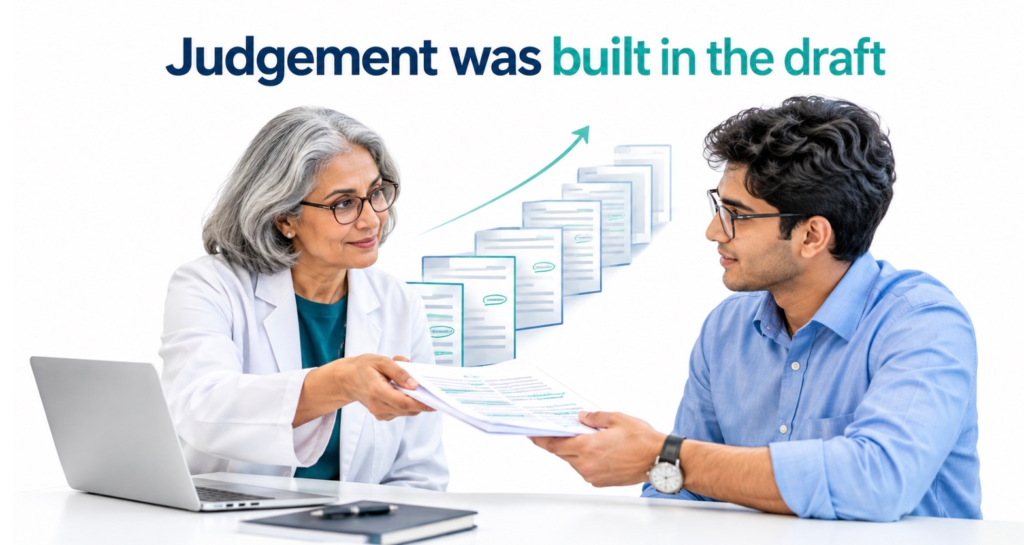
Think about how your best people learned their craft. The medical writer who now spots a weak CSR narrative at a glance first drafted dozens of them and got them back covered in comments. The safety physician who senses something wrong in a case series spent years processing cases and writing narratives. The regulatory lead who can predict an agency’s questions once drafted answers that a senior colleague took apart line by line.
None of this was designed as training. It was simply how the work got done. Juniors wrote the first draft, seniors corrected it, and judgement grew in the gap between the two.
Generative AI is very good at first drafts, so that is the work it takes over first, and the draft-and-correct loop goes with it. PwC’s Global Workforce Leader, Pete Brown, put it plainly: “AI is removing some of the routine work that once acted as an apprenticeship,” while “increasing demand for judgement, leadership and adaptability much earlier in careers”
Three Risks and Why the Third Matters Most in Pharma
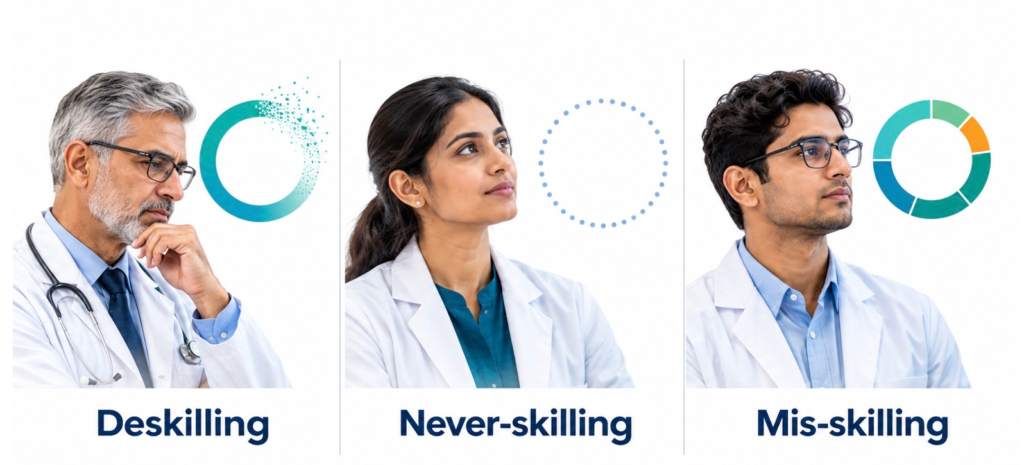
In one of my previous articles, I discussed deskilling: experienced professionals losing skills they once had. The best-known example is an observational study of experienced endoscopists. Their adenoma detection rate in non-AI colonoscopies fell from 28.4% to 22.4% after AI was introduced into routine practice.
A 2025 New England Journal of Medicine paper named two further risks:
● Never-skilling means never developing a foundational skill at all, because AI did the task first.
● Mis-skilling means quietly absorbing an AI tool’s errors into one’s own reasoning.
A 2026 Nature Medicine Perspective developed the never-skilling concept further. Commentary on that paper describes the result as “false proficiency”: competence that looks real until the AI is taken away. The authors are careful to present never-skilling as a risk and a research agenda, not a proven finding, because direct evidence in medical trainees doesn’t yet exist. Deskilling is likely recoverable with practice. Never-skilling leaves nothing to recover.
Mis-skilling deserves more attention than it gets, because in pharma it spreads. Imagine a junior medical writer accepts an AI draft that describes a secondary endpoint in language usually reserved for the primary. Nobody catches it. The phrasing gets reused in the next document, then saved into a team template, then copied by the next new joiner. One person’s absorbed error has become the organisation’s standard wording. Each document looks fine on its own, and the problem only shows when someone compares them, often an inspector or a competitor’s legal team.
In The Guardian, a Stanford medical student and a Johns Hopkins trauma surgeon put it simply: a doctor who has forgotten how to reason can recover; one who never learned may not.
That difference matters for pharma. Deskilling can be fixed with practice and refresher training. Never-skilling can’t, because there is nothing to refresh.
What the Evidence Shows So Far
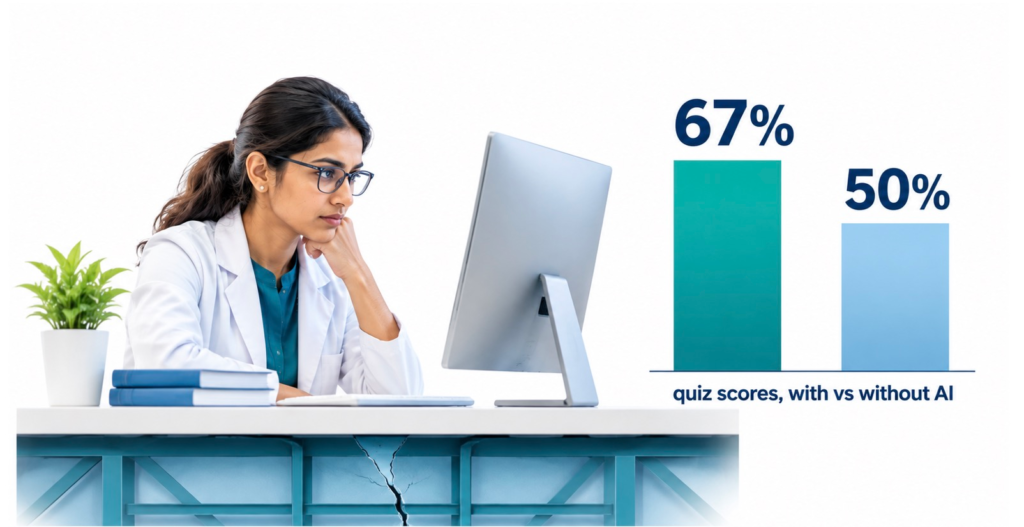
The most rigorous evidence so far comes from outside our industry. In a randomised controlled trial, Anthropic studied 52 mostly junior software engineers learning a new programming library, with and without AI help. On a quiz taken right after the task:
● The AI group averaged 50%, compared with 67% for those who worked by hand.
● The AI group finished slightly faster, but the difference was not statistically significant.
● The largest gap was in debugging: the ability to tell when work is wrong, and why.
The skill that suffered most wasn’t producing the work. It was spotting the errors in it, which is exactly what a future reviewer of AI output needs. The study was small and measured short-term learning, and its authors say so. They also found that how people used the tool mattered. Participants who asked conceptual and follow-up questions scored well. Those who handed the work to AI averaged below 40%.
Two further points from the same research should worry pharma leaders.
First, AI speeds up the expert and slows down the learner. Anthropic’s earlier observational work found that AI can cut the time for some tasks by 80% when people already have the skills. Put that next to the trial and you get a blind spot. Your productivity dashboards show your seniors’ gains, and those gains hide what your juniors aren’t learning.
Second, agentic AI is likely to make this worse. The researchers note that they expect the effect on skill development to be more pronounced with agentic tools, which complete whole tasks instead of assisting with parts. Pharma is rolling out agentic workflows for document drafting, case intake and literature review right now.
Wider workplace research points the same way. A December 2025 Work AI Institute report, produced with researchers from Notre Dame, Harvard and UC Santa Barbara, describes two outcomes. Used deliberately, AI pays a “cognitive dividend”; used as a reflexive shortcut, it builds up “cognitive debt”.
The report’s coauthor, Rebecca Hinds, warned that AI can create “this illusion that you have more expertise, more skills than you actually do,” and that even aware users find it “unclear where your knowledge ends and where the technology begins.” She named early-career roles, the traditional apprenticeships, as the most exposed.
Why This Is Sharper in Pharma
Every industry faces this, but ours has three features that raise the stakes.
The verification paradox. In regulated work, AI output is only acceptable if a qualified person checks it. But you can’t reliably check what you couldn’t have written yourself. If juniors never write, the industry slowly loses the people qualified to check.
Accountability doesn’t transfer. When a submission section, safety narrative or promotional claim is challenged, the question is whether the person who signed it understood it. A reviewer with false proficiency is a compliance risk that stays hidden until an inspector, or a patient, finds it.
The regulatory frameworks assume a competent reviewer:
● The joint EMA–FDA Guiding Principles of Good AI Practice in Drug Development (January 2026) begin with “human-centric by design” and call for “multidisciplinary expertise” covering both the technology and its context of use throughout the life cycle.
● The EU AI Act requires organisations that deploy AI to take measures supporting their staff’s AI literacy. National authorities have enforced this since August 2026. Where AI systems are classed as high-risk, deployers must also assign human oversight to people with “the necessary competence, training and authority.”
● Draft EU GMP Annex 22 sets out expectations for AI in critical GMP applications. The consultation draft excluded generative and probabilistic models from critical uses. EMA has since signalled it may allow them with safeguards, so expectations for human review are likely to become central.
● Long-standing roles such as the QPPV, the Qualified Person and the signing medical reviewer already make accountability personal. None of them can hand it to a tool.
Every one of these frameworks assumes a competent human reviewer. None of them explains where that reviewer will come from.
Expectations are rising, not falling.
PwC’s 2026 Global AI Jobs Barometer analysed 2.4 million US entry-level jobs. It found that AI-exposed entry-level roles are seven times more likely to require traditionally senior skills such as judgement and leadership. Openings for these roles have grown 35% since 2019, while other entry-level roles fell 10% (also reported by Computerworld). We are asking juniors to show judgment earlier, while removing the work that used to build it.
The senior experts who learned the old way will not be here forever. Unless we act deliberately, there won’t be enough people behind them who can do what they do.
The Pipeline You Can’t Buy Back
Many leaders assume they can hire experienced reviewers when they need them. The labour market suggests otherwise.
Employers are “moving away from ‘train-from-scratch’ hiring,” according to Experis, part of ManpowerGroup, while AI-attributed job cuts reached 87,174 by the end of May 2026, already more than the roughly 54,836 recorded for all of 2025. If every company stops developing juniors and plans to hire experienced people instead, the industry-wide supply of experienced people shrinks. Each company’s decision looks rational, but together they leave nobody to hire. Every firm assumes someone else will train the next generation.
Pharma has an extra exposure here: outsourcing. Much of the industry’s junior drafting happens at CROs and medical communications agencies. If those partners automate first drafts to protect their margins, sponsors lose a source of judgement they never directly owned and may not notice until they try to recruit from it. Ask whether your vendor contracts and governance reviews say anything about how your partners develop their reviewers.
PwC describes a “two-track” labour market. In “professionalised” roles, AI amplifies the expert, and these roles are growing faster in both jobs and pay. In “democratised” roles, AI makes the work easier for non-experts. Every pharma function is drifting onto one track or the other. A medical writer can become an expert who uses AI to go further, or an operator who fills in templates. Which track your people end up on depends largely on how you train them now.
7 Practices for Building Judgement Alongside AI
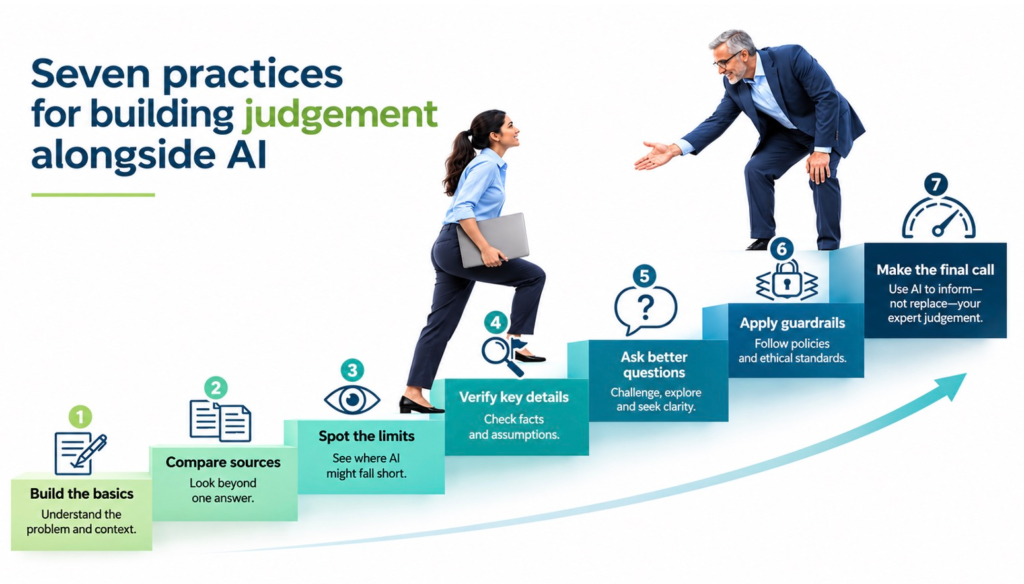
The answer isn’t to keep AI away from juniors. It’s to redesign the apprenticeship.
These are the practices I’ve seen work.
1. Build an AI-free foundation first. Some core tasks should be done without AI early in a career, until competence is shown. The Nature Medicine authors propose three phases for medical training: build baseline competence without AI, then develop critical judgement through structured teaching, then bring AI in under supervision. The same sequence suits medical writing, pharmacovigilance and regulatory roles.
2. Judge first, then compare. Before seeing the AI’s output, the junior writes their own assessment, even if it’s only a few bullet points: the key finding, the main risk, the question an agency is likely to ask. Then they compare it with the AI’s version. The tool becomes a sparring partner, not a substitute. Learning scientists Elizabeth and Robert Bjork call this kind of productive friction “desirable difficulty”: it slows people down in the moment but improves long-term retention.
3. Make expert review visible. When a senior rejects or corrects an AI draft, the reasoning usually stays in their head. Record what was rejected and why, and share it with juniors. Every review then becomes a teaching moment, and you build an auditable record at the same time.
4. Train on outputs with planted errors. Give juniors AI outputs that contain known errors: a dropped population qualifier, an invented citation, an unsupported subgroup claim, or a cross-trial comparison presented as head-to-head. Include some outputs with no errors, so they learn that over-scrutiny has a cost too. Error-finding is a skill that can be practised on purpose.
5. Use AI to explain, not just to produce. Encourage juniors to ask the tool why, not only what. Why this analysis approach? What does the source say about this limitation? What would an agency reviewer question? In the Anthropic study, this habit separated the high scorers from the low scorers.
6. Stage autonomy by consequence, and keep “manual” skills current. Juniors can use AI freely on low-stakes internal work. On anything that leaves the organisation or enters a regulated document, they work under supervision until they have shown they can catch what the tool gets wrong. Sign-off authority should follow demonstrated judgement, not time served. Aviation offers a precedent: the FAA advises pilots to keep their manual flying skills sharp by regularly switching off the autopilot. Regulated functions need the same discipline.
7. Measure capability, not usage. Rebecca Hinds of the Work AI Institute calls ranking employees by how often they click an AI tool “a big red flag.” Her advice is to tie AI to real outcomes such as quality, and to protect the parts of a role that build judgement. Every so often, assess juniors without AI: can they find the error, explain the finding and defend the decision? If adoption dashboards reward heavy use, you may be paying people to skip the learning.
The Trade-off Leaders Need to Accept

These practices will cost some of the short-term efficiency AI promises. Juniors who write first and compare later will be slower than juniors who simply accept the draft.
That is a deliberate investment, not waste. The alternative is a workforce that looks productive today and can’t oversee its own tools tomorrow. In an industry where the person who signs is accountable to regulators and patients, that risk isn’t worth taking.
The question to ask isn’t only “How much faster are our teams with AI?” It’s “In five years, who in this organisation will be able to tell when the AI is wrong?”
Found this article interesting?
Where to Start
This quarter, pick one function. Identify the three tasks through which juniors used to build the most judgement. For each one, decide which of the seven practices you’ll apply. Then ask your most experienced reviewers what they wish their juniors could see. Their answers will show you what your apprenticeship needs to protect.
Rebuild the apprenticeship, not just the workflow
The exercise above will show you what your apprenticeship needs to protect. Rebuilding it across a whole function, with tools your managers will actually use, is the harder part. That’s what ‘The Apprenticeship Layer’ Training is for.
New this October in the Pharma AI Enablement Institute and led by Dr Andree Bates, the course is built for the managers and senior experts who develop early-career talent in medical writing, PV and safety, regulatory, medical affairs and HEOR/access. It turns the seven practices in this article into a working programme.
You start building it during the course itself, with a planted-error drill for one role in your team.
You’ll leave with four working tools:
- A judgement-task map showing which tasks in your function build expertise, and which to protect from AI
- A staged-autonomy ladder that ties sign-off authority to demonstrated judgement, not time served
- A planted-error exercise bank built from your own documents, to train and test reviewers
- An AI-off capability check, so you know whether skills are forming instead of assuming they are
It pairs with The Judgement Layer training, our core module on evaluating AI output, so your experienced reviewers and the people they develop work to one standard.
Every quarter you wait, another cohort learns to accept the draft instead of questioning it.
Book a 20-minute call with Dr Bates to find where your function is most exposed →
Or explore the Institute →