
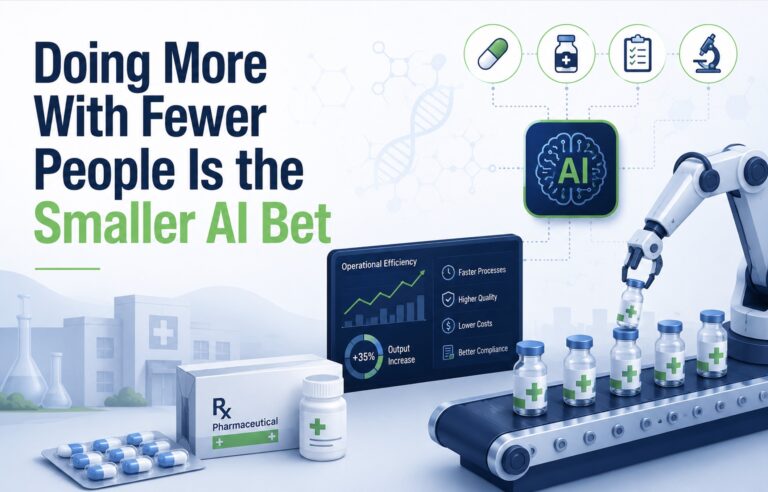
In recent months, I have heard versions of the same conversation repeatedly. A functional leader describes a reorganisation in which headcount is down by 10 to 20%, workload is not, and somewhere in the justification sits a slide about AI. Nobody says directly that AI will close the gap, but the language of digital and AI-enabled efficiency makes the implication clear. In many cases, AI is becoming the quiet logic behind leaner teams.
The pressure behind that logic is real. Between 2025 and 2030, pharma faces the largest wave of patent expiries in its history, with $236 billion to $400 billion in annual revenue potentially becoming contestable, while pricing pressure, tariff exposure, and a weaker biotech funding environment add to the strain. AI also does create genuine productivity gains: evidence synthesis can move from weeks to hours, and regulatory drafting can improve materially with the right workflows and training. The issue is not whether AI saves time, but whether those savings should automatically be translated into fewer people.
That is the real bet organisations are making. If headcount falls by 15 % while workload holds steady, the business is implicitly assuming a 20 to 30 % productivity lift from those who remain, yet that capability requirement is rarely stated, funded, or owned with the same discipline as the cost saving itself. A well-staffed team can absorb moderate capability, but a lean team depends on high capability, strong judgement, and sustained oversight. When that investment is missing, what remains is not a transformation plan but a licence count and a hope.
Where AI Value Leaks Away

This is where most AI value disappears.
Survey evidence points in the same direction. In a Deloitte survey of 280 medtech and pharma C-suite executives, only 9% reported significant return on AI investments. Broader enterprise reporting has also found that many generative AI pilots fail to produce measurable P and L impact. The issue is not that the models are incapable. In the right compliant environment, they clearly are capable. The issue is converting technical capability into usable, governed output at scale.
One of the most useful findings comes from Workday’s 2026 research. It found that employees gave back around 37% of the time AI saved them by correcting, rewriting or clarifying low-quality output. That number should change how leaders read their dashboards. Time to first draft may collapse. Total cycle time may not.
Research from BetterUp Labs, working with Stanford’s Social Media Lab, described a related problem as polished-looking AI output that lacks enough accuracy, context or judgement to be usable. They called it workslop. Around 40% of full-time desk workers reported receiving it in the previous month, and each instance took nearly two hours to resolve.
Read those findings together, and the real issue becomes clear. AI value is not settled by whether a model can draft a document. It is settled by whether that draft arrives good enough to use, and whether the time needed to check, correct and redraft it has actually been counted.
The Replace Bet and the Redeploy Bet
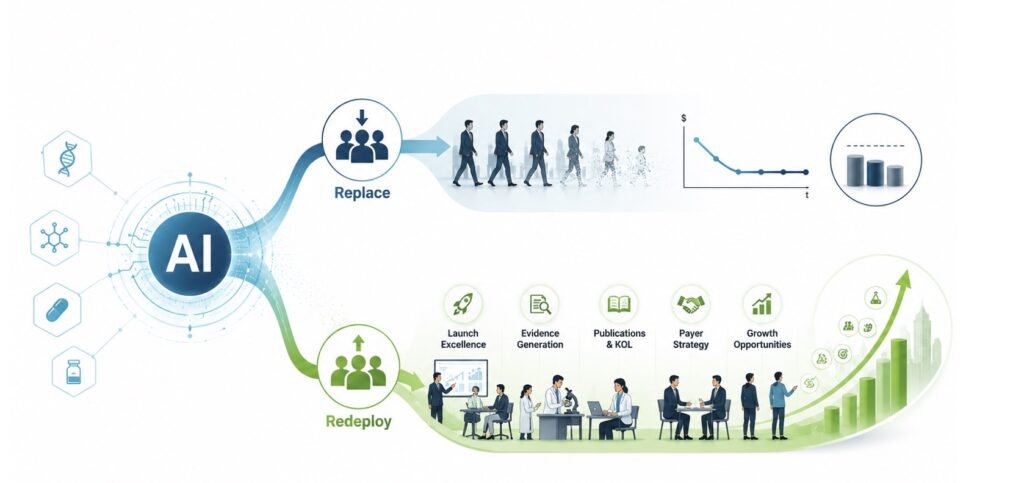
There are, in effect, two strategic options available when organisations apply AI to productivity.
The first is the replace bet, where higher output per person is used to reduce headcount and the return is captured through lower operating cost.
The second is the redeploy bet, where the same productivity gain is used to retain capacity and direct it toward work the organisation previously could not absorb. These are not just two ways of describing the same move. They lead to very different outcomes and reflect very different ambitions.
The replace bet is attractive because it is immediate, visible, and easy to defend. The financial return shows up clearly in the accounts, and the benefit can be attributed within the year. But its ceiling is limited, because the value is bounded by the cost of the roles removed.
In practical terms, the replace bet delivers:
● Lower headcount cost
● A measurable in-year saving
● A relatively clear financial narrative
● Limited upside beyond removed expense
● A risk of cutting capability that May later need to be rebuilt
The redeploy bet has a different logic. Instead of treating AI-enabled capacity as an opportunity to shrink the organisation, it treats that capacity as an asset to be redirected into higher-value work. In pharmaceutical organisations, this can create returns that are far more strategic than simple cost savings, particularly where the backlog of important but under-resourced work is already well understood.
Redeployed capacity can support work such as:
● Real-world evidence studies that were repeatedly delayed
● Deeper payer or patient segment analysis
● Additional indication assessment
● Publication backlogs that continue to build
● Stronger and better-coordinated launches
● Submissions that can move forward earlier
This distinction matters because the patent cliff is fundamentally a revenue problem, not just a cost problem. Organisations cannot cut their way through large-scale revenue exposure indefinitely. Cost action may create breathing room, but it does not generate the next wave of growth. Redeployment offers a broader return because it allows AI-enabled productivity to be aimed at evidence generation, access strategy, launch quality, and pipeline execution.
The reason the replace bet continues to dominate is not necessarily poor leadership judgment. It often wins because it is easier to measure. A removed role is visible, attributable, and auditable. Redeployed capacity is harder to express neatly in a profit and loss statement, even when the value it creates is significantly greater.
That is why leaders should assess both bets explicitly before deciding:
● What value will removed cost actually create?
● What high-value work could be unlocked if capacity were retained?
● Which option better supports growth, access, and pipeline performance?
● Are we solving only for near-term efficiency, or for long-term strategic return?
Not every workforce reduction is avoidable, and not every cut reflects poor thinking. Some are driven by loss of exclusivity, portfolio exits, or structural changes that leave little room for alternative choices. But in many cases, AI productivity is being used to justify reductions without a serious comparison to what redeployed capacity might have delivered. That is the comparison leadership teams should make more rigorously.
In Pharma, the Rework Lands on the Scarcest People
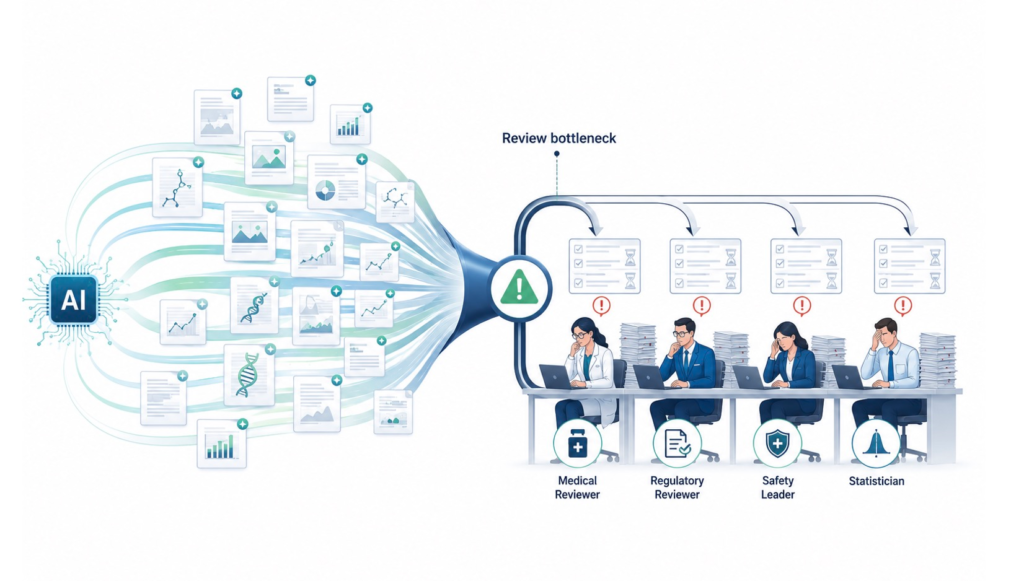
This matters more in pharma than in many other industries because the cost of imperfect AI output does not fall evenly across the organisation. It typically lands on the people who are already the most constrained: medical reviewers, MLR teams, regulatory QC, safety physicians, and biostatisticians.
These are high-value, audit-relevant roles, and they are often among the first to feel the strain when teams are thinned. As AI-assisted content increases, the burden on these reviewers rises at the same time that the capacity to absorb errors falls.
That is where the risk becomes operational. What once looked like manageable imperfection was often being quietly absorbed by expert review capacity. When that capacity is reduced, the same level of imperfection no longer gets absorbed; it turns into delay, backlog, and decision pressure.
Even a modest increase in review burden, combined with a reduction in reviewer capacity, can shift the benefit from visible savings to hidden bottlenecks. The savings do not vanish; it simply reappears later as slower dossiers, missed timelines, or rushed approvals.
How the Replace Bet Undermines Itself
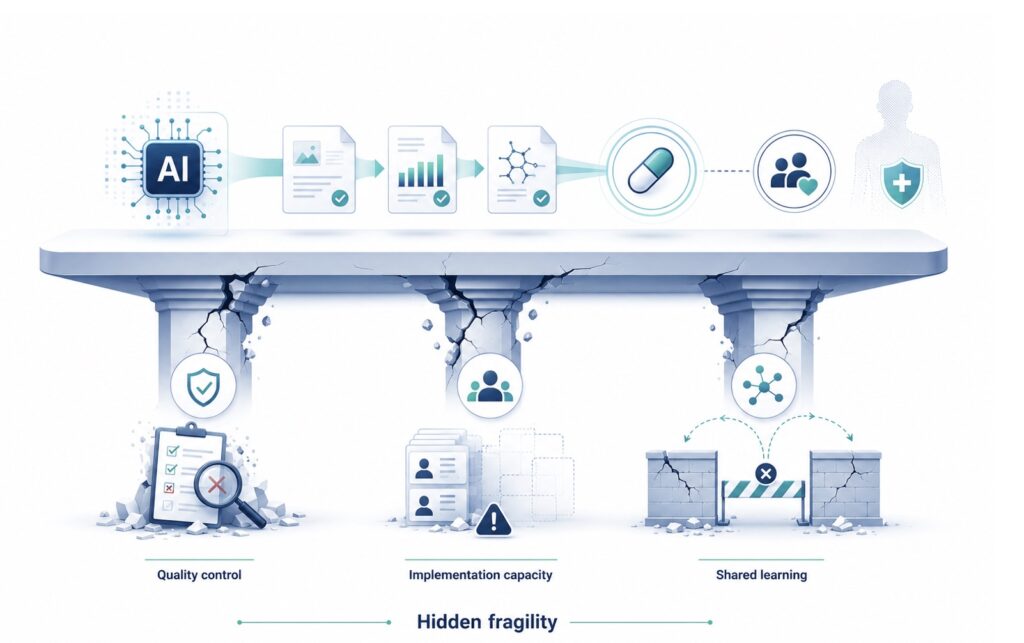
The cost led version of this strategy often destroys the leverage it is counting on in three ways.
First, it removes redundancy from the quality system. When several people touched a document, weak judgement calls were often caught by the second or third reader. When only one person touches it, that person becomes the control. The organisation has not just removed cost. It has removed redundancy from its quality system.
Second, it cuts implementation capacity. Someone has to redesign workflows, test prompts, validate outputs and work out what a tool is actually good for in a regulated context. That work is usually done by experienced people with enough cognitive space to improve the system around them. A reduction removes exactly that space.
Third, it suppresses the spread of good practice. AI capability usually diffuses informally. Someone finds a workflow that works and shows colleagues. But people only share those gains if they believe it is safe to reveal their own efficiency. Once AI-enabled productivity is visibly linked to headcount reduction, employees learn that demonstrable efficiency may become evidence for the next round. The result is not open resistance. It is quiet withholding.
That last effect is rarely modelled, but it may be one of the most consequential.
What Both Bets Depend On
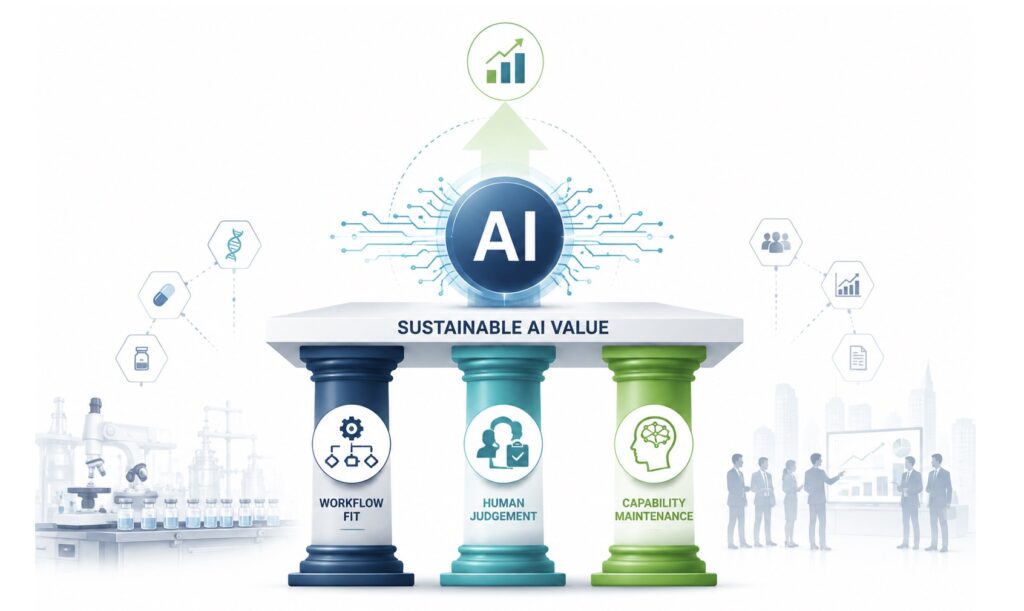
Redeployment is not the easy option. It asks more of the organisation, not less, because it requires people to operate at a materially higher level. But either bet only pays if three things are true.
First, the leverage has to land where the bottleneck is
In pharma, the biggest AI gains often sit in rare, high-stakes workflows such as annual payer dossiers, periodic safety updates, major submissions, launches, and publication plans. That is where weeks can become days.
But skill retention research points the other way. Capabilities decay fastest when they are not used frequently. Which means the highest value AI workflows in pharma are often the ones teams are least able to perform fluently when they come around again.
The saving in the business case is therefore concentrated in exactly the workflows least able to retain it.
Second, the judgement half has to be maintained
There are really two parts to using AI well. The first is procedural. Supplying the right source material, structuring the request and shaping the draft. The second is judgement. Deciding whether the output is accurate, defensible and safe to put in front of a reviewer, payer or regulator.
The judgement half matters more in regulated work, and it is also the part that is easiest to erode.
There is also a second problem beyond ordinary skill decay. The tools and the rules are moving underneath the user. Models are retired. Features change. Regulatory expectations evolve. So organisations face a two clock problem. People forget over time, and what they remember can become outdated even if they have not forgotten it.
That means AI capability in a regulated function cannot be treated as an annual training event. For many workflows, quarterly maintenance is closer to reality.
Third, someone has to own the maintenance
Most organisations have reached for a sensible first response by creating AI champions networks or communities of practice. The instinct is right and these groups should be protected. Capability does need trusted owners inside the business.
But in many pharma organisations, those champions are carrying that work on top of full-time jobs that have already absorbed extra workload after restructuring. The day job wins. And when the hardest workflow, governance or regulatory questions arise, champions cannot always substitute for dedicated expertise.
Generic AI literacy also does not solve the problem. What people need is not only awareness. They need role-specific capability in real workflows, under the actual constraints of their function.
The Regulatory Burden Does Not Disappear
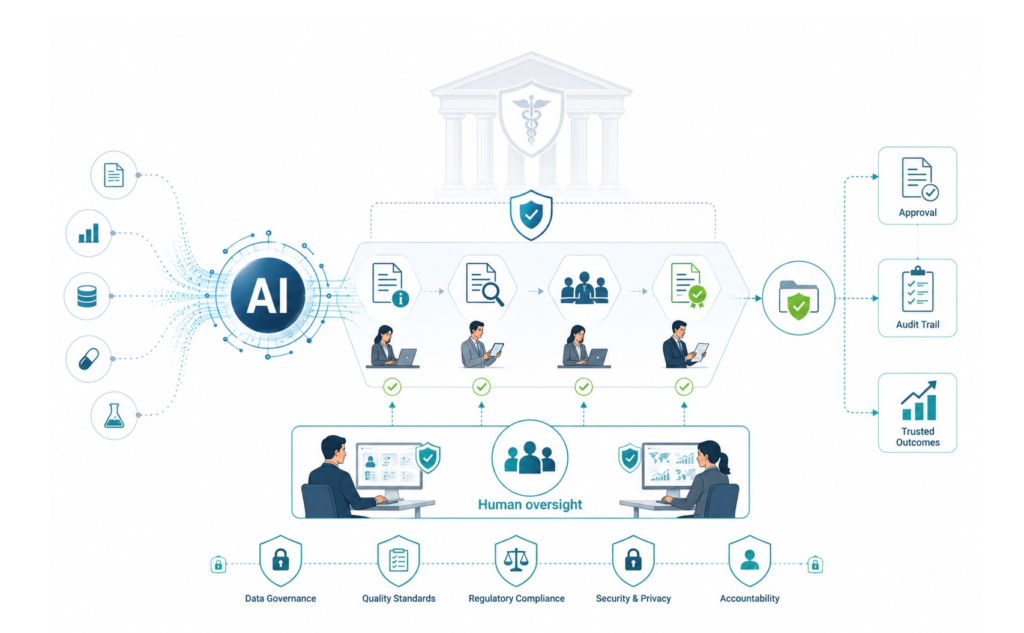
There is one more party to this wager that has not agreed to the casual version of it.
Whether you look at the EU AI Act, FDA guidance or EMA thinking, the direction is the same. The burden is not satisfied by historical training or enthusiastic adoption. It depends on current competence, human oversight, documentation and defensible use in context.
The inspection question is not whether people attended AI training. It is whether current AI use is controlled, documented and competently overseen. A leaner function has fewer people available to reconstruct how work was produced, and documentation discipline is often one of the first casualties when everybody is operating beyond capacity.
Six Questions Leaders Should Ask

Any leader whose plan assumes materially higher output from fewer people should be able to answer six questions.
1. Which bet are you actually making
Are you making a replace bet or a redeploy bet, and was that a deliberate strategic choice or simply the only model anyone ran?
2. What would the same productivity gain be worth if pointed at growth
Price the hours AI is supposed to free against the work your function has never had the capacity to do. Compare that with the salary line you plan to remove.
3. Which exact workflow is improving and from what baseline
If the saving cannot be tied to a named workflow with a before number, you have a licence deployment rather than a productivity plan.
4. Who reviews the output next and what happened to their load
Ask the reviewer, not the adoption dashboard. If review volume is up and review headcount is down, you know where the savings went.
5. Where is the maintenance line
What keeps this capability current 90 days from now when the tools have changed and the rare workflow comes round again?
6. What would tell you it is not working
Not 5 minutes after a training session, but 90 days later in real workflows. Look for cycle time on named tasks, safe use in actual regulated contexts, and the direction of travel on AI-related quality queries. Licence utilisation and satisfaction scores answer none of those questions.
The Part That Decides It

Doing more with fewer people can be made to pay. In some situations, it may be unavoidable. But it is the smaller of the two AI bets available.
Its upside is capped by arithmetic. It works only if organisations invest in the capability, review capacity and governance that make higher productivity real. And it is being chosen, in many cases, because it is the version finance can see most easily.
The larger bet is to use the same productivity gain differently. Not to remove capacity, but to recover it and point it at work that grows revenue, strengthens evidence, improves launches and gives the business a better chance of replacing what the patent cycle is taking away.
That is why the real question is not whether AI can make people more productive. It clearly can. The question is whether leaders are willing to fund the capability system that turns that technical potential into strategic value.
So here is the question I would leave with any leader whose plan for next year assumes their people will be 20 to 30% more effective than they are today.
Point to the line in the budget that makes that number true. Then tell me what you have decided to do with it.
One of those answers is a cost programme. The other is a strategy.
I’m curious about one thing.
If your organisation has cut headcount with AI somewhere in the justification, did anyone actually model the redeploy alternative?
I’d like to know how often the answer is yes.
If your organisation has cut headcount with AI somewhere in the justification, did anyone actually model the redeploy alternative? I’d like to know how often the answer is yes.
Found this article interesting?
On the third condition above i.e. that someone has to own the maintenance,
I have written it up properly. The AI Capability Crisis in Pharma covers why AI capability in a regulated function has roughly a ninety-day half-life, what the EU AI Act’s rewritten Article 4 now expects you to be able to show, and how to move AI capability out of discretionary training spend into the standing investment line where pharmacovigilance and quality competence already sit. It also prices recovered capacity – the number this article stops short of.
Sign up here and it arrives on 1 September: https://eularis.com/capabilitywp/
It’s the thinking behind the Pharma AI Enablement Institute, which opens 2nd September.
The strategy-side version of this question – which decisions AI should actually be pointed at, and what each is worth – is the work I do as an AI Strategic Blueprint. That’s a different conversation, and a longer one. https://eularis.com/ai-strategic-blueprint-for-pharma/
For more information, contact Dr Andree Bates abates@eularis.com.