
There is a meeting that happens in many pharmaceutical companies about eighteen months after the AI budget is approved.
The slides are polished. There is a portfolio of pilots, each with a sponsor and a status. Most are amber. Someone from Digital presents the platform. Someone from IT confirms the enterprise licence is live for twelve thousand people. Someone from Medical Affairs describes a proof of concept that worked beautifully and has not been used since the person who built it moved roles.
Often, the person who owns learning and capability is not in this meeting at all. That turns out to matter.
Then someone senior asks the question the meeting exists to avoid: What has actually changed in how we work?
In many of these rooms, the honest answer is: less than the investment promised.
Not nothing. There are pockets of value, a handful of heavy users, usually one excellent team in one market that really has worked it out. But not at the scale the business case implied.
That is the moment where a lot of organisations misdiagnose the problem. They reach for a technology explanation. Usually, the technology is not the issue.
The Explanations That Miss the Point
When AI investment does not translate into changed ways of working, four explanations usually appear.
- The model wasn’t good enough. So the company waits for the next release, buys a second model, or commissions an evaluation of four vendors. The next model arrives and is genuinely better. Adoption does not materially change.
- We chose the wrong platform. So procurement runs again, onboarding improves, the launch gets a communications campaign, and usage spikes briefly before settling close to where it was before.
- Our data isn’t ready. Sometimes true, often partly true, and dangerously expandable. Data readiness can absorb two years and an entire AI budget without ever being falsified, because there is always one more system to integrate.
- The organisation is resistant to change. In my experience, this is often overstated. What I see far more often is not reluctance but uncertainty: people know this matters, they have been given a tool, and they are not confident what to do with it in their workflow in the middle of a normal Tuesday under a deadline.
That last point matters. It points to a different diagnosis entirely.
The Real Pattern Behind Low Adoption
Here is the pattern I see most often.
A company invests seriously in AI: enterprise licences, governance, security review, internal communications, sometimes an internally hosted model or a bespoke build with a very real price tag attached.
Then usage quietly concentrates.
- A small group use it constantly and get real value.
- A larger group use it for low-risk tasks such as summarising documents, drafting emails, or preparing first-pass notes.
- Most try it a few times, find the output no better than what they would have produced themselves, often because nobody has yet shown them how to get pharma-grade output from it, and stop.
The usual conclusion is that the tool underperformed.
Often, it did not. It worked well for the people who knew how to use it.
Those people are not more intelligent than their colleagues, and they do not have better access. They have something else: practical working knowledge. They know what to give the model, what to ask it for, how far to trust the answer, how to improve it, and when to disregard it entirely.
That is not a technology gap. It is a capability gap.
And it is the thing most organisations did not really budget for, because the business case was written around software.
Why Pharma Feels This More Sharply
Every industry has some version of this problem. Pharma has three features that make it more expensive.
First, the work is judgement-intensive. The high-value tasks in pharma are not throughput tasks. A medical information response, a payer dossier, a regulatory submission, an MLR-compatible piece of content, a safety narrative, and these are not documents you generate; they are documents you are accountable for. AI helps enormously with them, but only in the hands of someone who can tell a strong draft from a plausible one. That distinction is a skill. It is teachable. It is not intuitive, and it is not evenly distributed across your organisation right now.
Second, the cost of error is asymmetric. In most industries, a wrong output is inefficiency. In yours, it can be a compliance event, a regulatory finding, a patient safety issue, or a promotional claim that should never have left the building. Which means capability is not only a productivity question in pharma. It is a control question, and controls that depend on individual judgement only work if the judgement is real.
Third, the environment keeps moving. Guidance under the EU AI Act has continued to develop, regulators on both sides of the Atlantic have published and revised expectations on validation and human oversight, and internal policy in most large pharma companies has been rewritten at least once in the last eighteen months. A team trained on last year’s governance position is not merely rusty. It may be confidently applying a rule that no longer holds.
Put those three together, and you get a familiar but rarely named condition: capable-looking teams operating with incomplete or stale working knowledge in a regulated environment.
Training Works. The Problem Is What Happens After.
I want to be precise here, because this is the point where most commentary on corporate training goes wrong, and where I part company with it.
Training works. Not “can work under ideal conditions” but works, reliably, and I can evidence it. Teams I have taught change how they operate, and they say so publicly, on the record, with their names and their employers attached. You will see this in my LinkedIn recommendations. People describe specific tasks that used to take days or weeks that now take hours. That is not a satisfaction score. It is changed practice, reported months later by people with reputations to protect.
So let me tell you what a good session actually looks like ninety days out, because it is more interesting than either of the stories you usually hear.
Two months ago I trained a value and access team. I am still getting emails from that room. Evidence synthesis that used to take weeks is coming back in hours. Dossier support rebuilt. One person who redesigned one of their workflows around something we did in the training, which is saving them weeks. The training took.
Three people from that same team have also emailed asking for a reminder of how to do something specific they were shown, and said they would love another session.
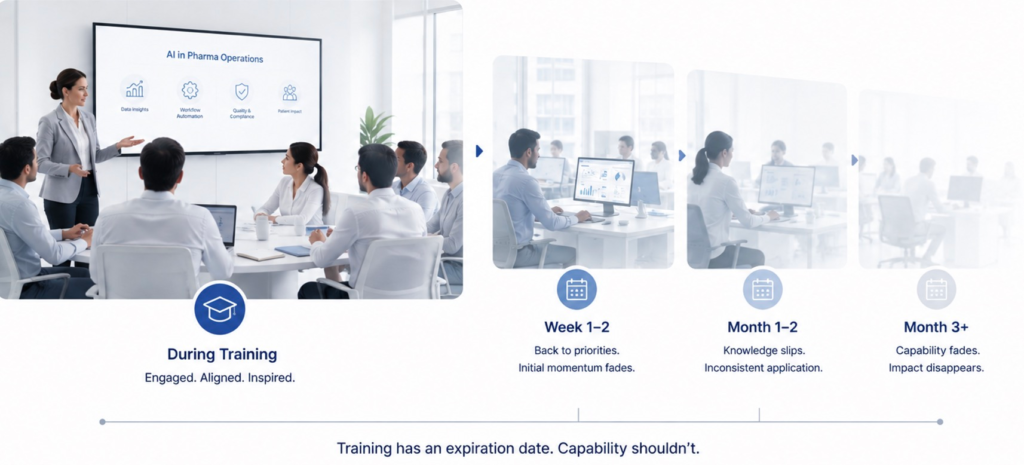
Both of those things are true at once, and neither cancels the other. That is what decay actually looks like from the inside: not a cliff that everyone falls off at once, but an uneven erosion that takes different things from different people at different rates.
And that is not one unusual room. I have the same pattern from regulatory affairs teams, from commercial functions, and from rooms of external clinicians. The messages about what is working and the requests for a refresher arrive from the same programme, in the same period, from different people.
The daily habits stay. The occasional workflows go first.
And note the interval. Two months, comfortably inside the window in which the research below says retention should still be likely.
And it turns out this is exactly what the evidence predicts.
What the Research Says, and Where It Stops

Skill decay after training is one of the better-measured phenomena in organisational psychology. Two meta-analyses matter here, and they cover different halves of the problem.
The first is about procedure so the how-to layer. Tatel and Ackerman, writing in Psychological Bulletin in 2025, pooled 1,344 effect sizes from 457 reports on procedural skill retention and, for the first time in this literature, treated the retention interval as a continuous variable rather than dividing it into broad bands. That matters because it changes the shape of the conclusion. The result is a gradient, not a cliff. [1]
Half the initial gain in accuracy-dependent procedural skill is gone at around six and a half months of non-use. Speed-based skill holds roughly twice as long. And the coded task categories include medical and dental procedures, so this is not a laboratory curiosity.
Read that carefully, because it is not what most commentary on corporate training claims. It does not say the training failed. It says the gain was real, and then began to erode at a measurable rate from the moment the session ended. There is no single threshold at which everything is suddenly lost. There is a slope, and everyone stands on it from day one.
Which is precisely why, in that value and access team, three people asked for a reminder while everyone else was still sending me examples of what was working.
That covers the workflow half – knowing how to actually run the thing you were shown. It does not cover the harder half.
For that, the relevant work is older. Arthur and colleagues, in 1998, pooled 189 effect sizes across 53 studies and found two things this industry should care about more than it does. [2]
- First, where the slope becomes reliable. Below about ninety days of non-use the evidence is genuinely mixed. Some studies show decay, some show performance holding, some even show improvement. Beyond ninety days that ambiguity largely disappears: decay appears consistently, and by one year without practice the effect is very large. Ninety days is therefore not the point at which knowledge disappears. It is the point after which you can no longer safely assume it is still there. Before ninety days, retention is likely. After ninety days, retention becomes a lottery, and most organisations are running that lottery without knowing who has retained what.
- Second, decay is not uniform across kinds of work. Physical skills hold up comparatively well. Cognitive work erodes faster, and work judged on accuracy erodes faster than work judged on speed anf Arthur puts that gap at roughly three to one.
Now put your teams’ actual AI work against those two findings, because it splits cleanly in two.
Running the workflow so supplying the right source material, structuring the request, working a draft into usable shape, etc., is procedural. It decays like procedure, on the curve the 2025 paper measures.
Deciding whether that draft is defensible enough to put in front of a reviewer, a payer or a regulator is not procedural at all. Nor is assessing whether a generated summary faithfully represents its source, or judging whether a drafted response would hold up. That is cognitive, accuracy-dependent judgement, and it sits in the fastest-eroding category either paper identifies.
Which means an organisation loses the two halves at different rates, and loses the half that carries the regulatory consequence faster.
There is also another mechanism worth naming, because it reverses how many organisations think about training investment. Decay is driven by non-use. Both meta-analyses identify frequency of performance as a critical determinant of whether a skill is retained.
That has a direct implication:
- The tasks your people do daily are more likely to hold.
- The tasks they do quarterly, biannually, or annually are far less likely to.
And if you look at where AI creates the greatest value in pharma, you find a great many of the second kind:
- the annual payer dossier
- the periodic safety update
- the submission that comes round twice a year
- the launch that happens once
These are exactly the workflows where AI can save the most time. They are also exactly the workflows your people are most likely to have forgotten how to run by the time they need them again.
The highest-value use cases decay fastest. That is not a training failure. It is arithmetic.
The Second Decay

Everything above describes the ordinary curve of skill decay. It applies across many domains: project management, negotiation, aseptic technique. Your learning function already knows this and it is standard learning science, and most of the people running capability in pharma could have told you the shape of that curve before I did.
AI introduces a second decay on top of the first, and this one has no formal literature yet, because it is still too new.
Ordinary skill decay assumes the object of the skill remains relatively stable while the person forgets. Aseptic technique does not change while you forget it. AI does.
The model your Medical Affairs team was trained to use carefully may now behave differently than it did during the training session. Prompting methods considered best practice a year ago may have been superseded by approaches that are simpler and better. Capabilities that did not exist when the training was designed, including document handling, retrieval over internal material, tool use, and agentic workflows, may already be sitting inside the interface your people use every day, untouched, because nobody told them the interface had changed.
So two curves are running at once:
- Memory erodes – fastest in the accuracy-dependent judgement work that matters most in pharma, and fastest of all in the tasks performed least often.
- Relevance erodes – because the tools, methods, and best practices do not stand still.
That is where my ninety-day figure comes from.
The published research places memory decay alone at roughly six and a half months to lose half the gain. That is the first term, and it is measured.
The second term which is the rate at which the material itself becomes outdated, has not yet been formally measured, because we have not previously had a subject moving this quickly. My working estimate, based on close observation of many teams in practice, is that the compound effect of these two decays runs at about ninety days in this field.
That is a practitioner’s number, not a published one. I would be very happy to see it corrected by better data. It is also why I am now collecting that data.
What is not really in question is the shape of the problem:
- two decays
- compounding
- acting in the fastest-eroding category of work
- on the tasks that matter most
- and are performed least often
What makes this particularly dangerous is that it often does not feel like anything from the inside.
- The people were trained.
- They have the certificate.
- They are confident.
And confidence decays slowest of all.
That is the part a regulated business should worry about most, because the failure mode is not someone who knows they are unsure. The failure mode is someone who is certain, and out of date.
In an unregulated industry, that gap produces inefficiency. In yours, it produces exposure.
Why the Usual Answers Don’t Close It
None of the standard responses are wrong. The issue is that they are generally built for a problem that stops.
The AI taskforce or champions network
If you already have an internal AI taskforce or champions network, you are ahead of many of your peers, and you should protect it. The instinct behind it is sound: capability needs owners inside the business, not just a vendor on retainer.
The people who step into these roles are often among the strongest people in the organisation:
- curious
- generous with their time
- trusted by their colleagues in ways external experts rarely are
But two questions are worth asking privately.
- How much of this work are they doing on top of their actual job? In most pharma organisations, internal AI networks are volunteer efforts layered onto full-time roles. Creating content, running sessions, and keeping up with what has changed all compete with the work these individuals are actually paid and measured to deliver — and naturally, those formal objectives win.
- What happens to the hardest questions? This is not because your champions are not capable. It is because they are usually enthusiasts rather than specialists, doing this in the margins of a demanding role. Some questions require someone whose full-time focus is precisely this work. In practice, those harder questions are often parked, guessed at, or quietly dropped. They are also, reliably, the ones carrying the most risk.
The conclusion is not that the champions network is the wrong answer. It is that many organisations have effectively asked a group of volunteers to outrun a decay curve in their spare time. Whatever comes next needs to make their lives easier, not add to their burden.
A note on the learning and capability function
The same point applies, with more force, to the people whose job title actually contains the word capability.
Learning leaders in pharma are not behind on this. In my experience they are usually the first people in the building to raise it, and they raise it early. They know the retention literature. They have argued for reinforcement, spacing and follow-through, often for years, and often against a budget cycle designed to fund events rather than maintenance.
What they are typically not given is any of the three things this particular problem requires: a mandate that extends past the end of a programme, a vendor-neutral technical view of what changed in the tools last month, and a budget line for maintenance rather than delivery. Every learning function I work with can design reinforcement. Very few have been resourced to track a subject that moves weekly, on top of everything else they own.
So when the rest of this article talks about a structural absence, it is not a comment on that function’s competence. It is a comment on a scope that was drawn before anyone needed to keep pace with a technology that changes monthly — and on the fact that nobody has since redrawn it.
Training
I deliver a great deal of training, and I will defend it. A well-designed session remains the fastest way to move a team from theoretical awareness to changed practice. There is ample evidence of that, including the public examples on my LinkedIn with people’s names attached.
But a training session cannot, on its own, hold the line against a decay curve.
That is what decades of research on post-training retention tell us. The session is ignition. It is also a snapshot of a moving object, taken on a particular day.
The mistake is not running the workshop. The mistake is asking an event to do a system’s job, and that is usually a decision made at the point of purchase, by people who were handed a training budget and no maintenance budget, rather than by anyone in the room on the day.
That value and access team did not need better training. They needed the specific things they had forgotten, at the moment they realised they had forgotten them. And the people who asked for another session were not reporting a failure. They were the ones paying attention. Three people read the situation correctly and asked for the only thing that closes it, which is more than most organisations manage at the two-month mark.
Tooling and enablement
Better interfaces, prompt libraries, and internal portals are all useful. But they are all subject to the same decay, and none of them supplies the critical layer of judgement.
A prompt library can tell someone what to type. It cannot tell them whether what came back is any good.
That is the common limitation across these otherwise sensible interventions: each treats capability as something you can achieve.
- something with a completion date
- something that can be marked as percentage complete
- something that can be given a green status on a slide
Capability in this field does not have a completion date. It has a rate of decay.
You either have something that runs at least as fast as the decay, or you have a number on a slide that happened to be true in March.
The Question to Ask This Week

I am not going to set out the answer today. That is what the whitepaper on 1 September is for.
Before then, a better starting point is a diagnostic you can run yourself, inside your own function, without a consultant in the room.
1. When were your people last trained on AI?
Not informed. Not licensed. Trained. Month and year.
If it was more than a quarter ago, the research above already tells you a great deal of what you need to know.
2. What has changed since then?
Specifically:
- in the tools they use
- in the guidance that governs them
- in the techniques that were current when they learned
If nobody in your function can answer that clearly, then nobody is currently watching the thing your controls depend on. In most companies that is a gap in someone’s mandate, not a gap in anyone’s competence.
3. Who owns keeping it current?
- Not who owns the platform.
- Not who owns the policy.
- Who owns the working knowledge of the people doing the work?
In most organisations I enter, this question produces a pause. Then a name is offered tentatively. Then someone points out that it is not really that person’s job, and they are right, because it was never written into anyone’s job.
That pause is what I mean by a capability problem.
It is not a failure of ambition, budget, or intelligence. Those are usually present in abundance. It is a structural absence: nothing is explicitly responsible for the rate at which the industry’s most important new skill goes out of date.
What This Costs, and What It Is Worth
If you accept that diagnosis, then much of what has been written off as failed AI investment looks very different.
In many cases:
- the tools mostly worked
- the models were mostly good enough
- the training mostly landed, and yes, I can show you the messages
The pilots that stalled at seventy or eighty per cent complete did not usually stall because of technical impossibility. They stalled because the people who might have carried them through the last stretch no longer had the working knowledge to do so, and the one person who did had moved on.
That is a better position than it may sound.
- A technology problem requires you to wait for someone else to solve it.
- A capability problem sits entirely within your control.
And capability compounds. The same team, kept genuinely current, gets more from every subsequent tool you buy, including the tools that do not yet exist.
But it only compounds if it is maintained.
Otherwise you are funding the same ignition on a cycle. Most learning leaders I speak to can already see that happening. What they generally do not have is the mandate, the mechanism or the budget line to stop it, and that is the gap worth closing.
The functions that will lead in AI over the next three years will not be the ones that bought the most training or the most licences. They will be the ones that understood a basic operational truth:
Capability has a rate of decay, and they built accordingly.
The Full Research Publishes on 1 September
This article is the short version of the argument. The long version and the White Paper ‘The AI Capability Crisis in Pharma’ publishes on 1 September.
It contains the evidence in full, the mechanism behind both decay curves, what the moving regulatory position actually requires of a training record, the three hidden costs of episodic AI learning, and what a maintained capability model looks like in practice, including the arithmetic you would need to make the case internally.
It is written for functional leaders, L&D heads and compliance officers in pharma and biotech. There is no charge and no gate beyond an email address.
[ I am in Pharma. Send me the whitepaper on 1 September → Click Here]
One email, on the morning it lands. If you would rather not wait, and you want to talk about how this applies to your own function, reply to this and I will find twenty minutes.
Dr Andree Bates has worked on AI inside pharmaceutical companies since 2003. Through Eularis she has delivered AI programmes for the majority of the world’s largest pharma organisations.
References
[1] Tatel, C. E., & Ackerman, P. L. (2025). Procedural skill retention and decay: A meta-analytic review. Psychological Bulletin, 151(6), 696–736. https://doi.org/10.1037/bul0000481
[2] Arthur, W., Bennett, W., Stanush, P. L., & McNelly, T. L. (1998). Factors that influence skill decay and retention: A quantitative review and analysis. Human Performance, 11(1), 57–101. https://doi.org/10.1207/s15327043hup1101_3
Want to know more?
The Full Research Publishes on 1 September
This article is the short version of the argument. The long version with all the research and the solution. i.e. the White paper ‘The AI Capability Crisis in Pharma’ publishes on 1 September.
It contains the evidence in full, the mechanism behind both decay curves, what the moving regulatory position actually requires of a training record, the three hidden costs of episodic AI learning, and what a maintained capability model looks like in practice, including the arithmetic you would need to make the case internally.
It is written for functional leaders, L&D heads and compliance officers in pharma and biotech. There is no charge and no gate beyond an email address.
[ I am in pharma. Send me the whitepaper on 1 September → Click here ]
One email, on the morning it lands. If you would rather not wait, and you want to talk about how this applies to your own function, reply to this and I will find twenty minutes.
Dr Andree Bates has worked on AI inside pharmaceutical companies since 2003. Through Eularis she has delivered AI programmes for the majority of the world’s largest pharma organisations
For more information, contact Dr Andree Bates abates@eularis.com.