
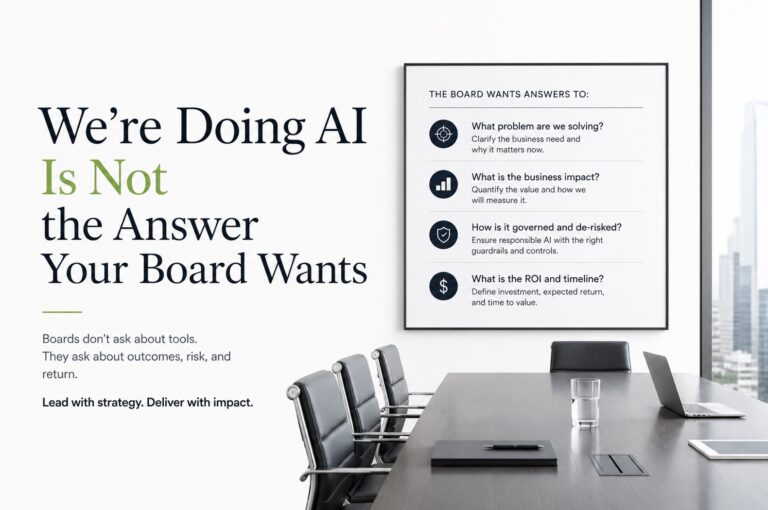
There is a moment I have seen play out in pharmaceutical boardrooms again and again. It usually comes in the second half of the agenda, when a non-executive director asks a deceptively simple question: what is our AI strategy?
The response is often confident.
“We have initiatives underway. We have built a data science function. We are running pilots in medical information, field force planning and regulatory intelligence. We have a platform partner. We have a steering committee that meets monthly.”
The room nods, because it sounds like an answer.
It is not one.
There’s a second version of that answer. A better one. More considered, and I hear it just as often, if not more often, now than the first. It goes like this:
“We do have a strategy. We ran a proper process. We went out to every business unit and asked them where AI would make a difference – where the real pain is, what they’d actually use. We scored what came back. We prioritised. And we’re working through the list.”
That one is harder, because it sounds like rigour. And the person giving it has genuinely done more work than the person giving the first one.
Neither of them is a strategy.
What the board asked for was not an inventory of activity. It was a strategy: what choices are we making, in what sequence, on what basis, at what cost, and with what expected return?
That gap cannot be closed by presenting the same material more crisply disguised as rigour. It reflects a deeper problem: many pharmaceutical companies are active in AI, but far fewer have an AI strategy the board can truly govern.
The first answer is an inventory of activity. Pilots, vendors, headcount, governance structures, cadence. The second is an inventory of demand – what people across the business would like AI to do for them. Every item in both is true.
The second answer is not strategy. It is crowdsourcing. Two things are wrong with it, and I will come back to both. The submissions are rarely original – ask a business unit what AI could do for it, and you get back what it has already seen, at a congress, in a competitor’s release, in a vendor’s deck three weeks ago. And even where the submissions are genuinely well chosen, nothing in them can tell you so. Whether a use case belongs among the best available routes to your corporate objectives is a question about magnitude of financial contribution, and that cannot be answered by inclusiveness, by feasibility scoring, or by sponsor conviction, however senior the sponsor.
Until the modelling is done, a ranked list is not a prioritisation. It is a longlist waiting for one.
And I want to be careful here, because I am not saying don’t ask the business units. Ask them about their pain points – they hold operational knowledge no central function can reconstruct. But treat what comes back as input to an analysis, not as the output of one. The submissions tell you what people can see from where they sit. Strategy requires knowing what is worth most from where the board sits to the overall organisation.
Neither one of the illustrative answers above is an inventory of value to the organisation.
A board isn’t asking what you’re doing. A board is asking what you’re deciding – on what basis, in what order, at what cost, and with what expected return. That gap cannot be closed by framing the same material more crisply for the board pack. It is, in my experience, worth tens of millions of dollars and several years of competitive position.
And here’s what makes it genuinely difficult.
The people giving that answer are not naive. Most of them know, somewhere at the back of their mind, that the answer was thinner than it sounded. That’s precisely why the question lands the way it does – there’s a small internal flinch. They have the activity. They’re not certain they have the strategy. And they suspect, correctly, that those are very different things.

Why Activity Gets Mistaken for Strategy
Activity is visible. Strategy is structural.
Activity produces artefacts: pilots, demos, dashboards, vendor updates, steering committees, launch plans. These create momentum, and momentum can easily be mistaken for strategic progress.
That is the trap.
Any individual AI initiative can usually be justified on its own merits. A pilot may solve a real problem. A vendor may be credible. A use case may be technically feasible. A team may be doing good work.
But individually defensible is not the same as collectively coherent.
The question that exposes the difference is not, what are you building? Most leadership teams can answer that fluently.
The harder question is this:
How does the capability you are building in one part of the business make the capability you are building elsewhere more valuable and how do they contribute to the organizations growth and what is that exact contribution?
That is where many portfolios begin to unravel.
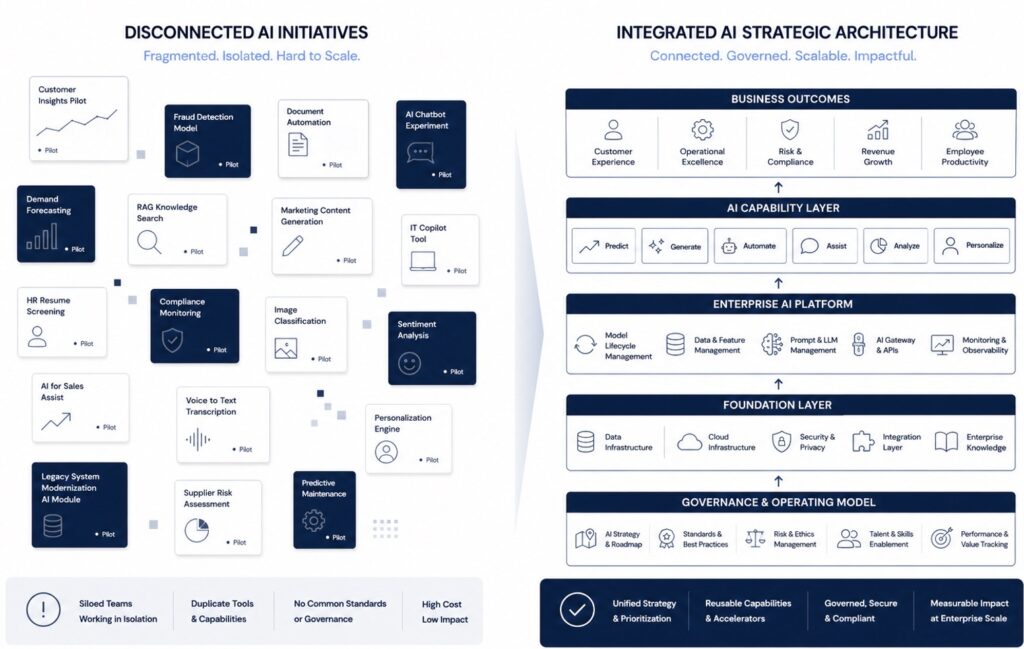
Too often, initiatives sit alongside one another rather than building on one another. They do not compound across the enterprise. In pharmaceuticals, that matters enormously. The value of AI is not simply in isolated local gains. It is in how insight, data and decision support begin to reinforce one another across clinical development, medical affairs, commercial, market access, regulatory and operations.
If your initiatives are not compounding, you do not yet have a strategy. You have a collection of projects. And a collection of projects is difficult for a board to govern, because it does not express a clear thesis, a sequence of choices, or a basis on which management can be held to account.
When leadership teams sense this gap, they often reach for the wrong explanation. The diagnosis usually falls into one of four familiar categories:
● Speed: the technology is moving faster than we are
● Talent: we need more data scientists or AI specialists
● Adoption: our people are not using the tools
● Vendors: we backed the wrong partners
None of these explanations is necessarily false. That is precisely why they are dangerous. A partly right diagnosis can absorb years of executive attention and significant capital while the real constraint remains untouched.
The talent diagnosis is the most instructive of these. It is usually acted on by recruiting specialists into a central function, when the binding constraint is more often the working competence of the people expected to use AI inside their own roles. Those are different problems, and solving the first does not touch the second.
What, then, actually constrains value?
Across more than two decades of AI strategy work in life sciences, I have found that failure to realise value from AI investment usually traces back to five structural conditions.
The Five Structural Conditions That Constrain AI Value
1. The Value Prioritisation Gap
This is the first and most important condition, because it tends to precede and amplify all the others. It is also the one least likely to be recognised as a strategic failure.
At its core, it is the absence of a rigorously prioritised and financially modelled strategic view of where AI can create material value.
In many organisations, pilots are chosen because they address visible pain points. A team sees friction in medical information response times, field force planning, regulatory monitoring or content review, and proposes an AI solution. The initiative is real, relevant and often useful.
But a real pain point is not necessarily the pain point that most changes the economics of the business.
That distinction matters, especially when capital is constrained. Money spent solving a second-order problem is money no longer available for a first-order opportunity.
The way many AI portfolios are assembled deserves to be named clearly.
Leadership asks business units to submit candidate AI use cases. Medical affairs proposes literature triage. Commercial proposes next-best-action. Regulatory proposes intelligence summarisation. Manufacturing proposes predictive maintenance. A committee reviews the options and ranks them using some combination of feasibility, executive sponsorship and speed to demonstration.
The process feels disciplined. It is inclusive. It is structured. It produces a ranked list.
But it is not strategy.
It is crowdsourcing.
Two problems follow.
First, crowdsourced use cases are rarely original. Teams typically propose what they have already seen in the market: in conference presentations, competitor announcements or vendor decks. That creates a form of use-case copying that looks like internal innovation but usually leads to strategic sameness. Pharmaceutical companies with different data maturity, asset portfolios, therapeutic focus, market footprints and commercial models should not expect to create equal value from identical AI portfolios.
Second, even if every submitted use case is sensible, there is no reliable way to know whether it belongs among the best available strategic priorities until the financial modelling is done. Feasibility, enthusiasm and executive sponsorship do not answer the central question: which initiatives are most likely to create measurable business value?
Until that question is answered, a ranked list is not a prioritised strategy. It is a longlist waiting for economic judgment.
The issue is often not that organisations built bad pilots. It is that they never made the right strategic choices in the first place.
2. The Decision Rights Gap
In most organisations, the authority to start a pilot is relatively clear. The authority to scale one into an operational capability is much less so.
This is not usually negligence. It is a predictable consequence of how AI programmes often begin. They are set up as innovation efforts, funded outside the core operating model and governed for experimentation rather than enterprise deployment.
That works in the exploration phase. It becomes a liability when ambition shifts from test and learn to transform and scale.
At that point, many organisations encounter an invisible wall between pilot and production. Business units assume scale-up is a central decision. Central functions assume it requires business sponsorship or budget ownership. Legal, compliance, privacy and regulatory functions may exert effective veto power through risk review processes that were never formally integrated into the scaling pathway.
No single function is acting irrationally. Each is operating within a legitimate remit.
Yet the enterprise outcome is highly predictable: promising pilots are not explicitly rejected, but neither are they decisively advanced. They are deferred. They accumulate in the pipeline. They signal progress. They produce little enterprise value.
When pilots work and still do not scale, the problem is usually not the pilot. It is the transition.
3. The Data Ownership Conflict
Pharmaceutical organisations hold highly valuable proprietary data assets: real-world evidence, longitudinal field force data, market access histories, medical affairs interaction data, operational performance data and patient journey insight generated across the enterprise.
Properly structured, these assets can become a powerful source of competitive advantage.
In practice, however, they are often only partially available to the teams building AI solutions. That is not always because the data is missing. Nor is it necessarily because access is technically impossible. More often, the constraint is organisational.
Multiple functions hold legitimate governance interests in the same datasets, but no effective framework exists to reconcile those interests at the speed AI development requires.
For example:
● commercial may govern field force data because it reflects operating performance
● medical affairs may govern engagement data because of HCP interaction and compliance requirements
● regulatory may control real-world evidence under frameworks designed for more static analytical use
Each of those positions can be entirely reasonable in isolation.
Together, however, they often create an environment in which AI teams work with the data that is easiest to access rather than the data that is most valuable to the business.
The result is a familiar but underappreciated failure mode: a solution that is technically sophisticated and strategically underpowered at the same time.
4. The Incentive Architecture Misalignment
This is the most consistently underestimated of the four so far, and often the one discovered last.
When adoption is low, the standard response is change management. More training. More communication. More advocacy from leadership.
Sometimes that helps. But it often misses the real issue.
Low adoption is not always a behavioural problem. In many cases, it is a rational response to the incentive environment.
Consider a high-performing medical science liaison. You are asking that person to modify established workflows, use AI-generated recommendations, enter information differently and trust outputs they may not yet fully believe in. In return, you are offering the possibility of improved productivity at some future point.
From the perspective of the individual, the arithmetic is straightforward:
● the cost of adoption is immediate
● the friction is visible and personal
● the benefit is delayed
● the benefit is uncertain
● and much of the value accrues to the organisation, not directly to the user
That is not resistance to change. It is rational behaviour inside the system you have designed.
Which means the solution is not just better communication. It is redesign of the performance environment itself, often involving coordination across business leadership, HR and finance, and in some cases changes to compensation, reporting lines, objectives or workflow expectations.
That work is harder than launching a pilot. It is also far more decisive.
You cannot pilot your way out of an incentive problem, and you cannot delegate it to a digital team.
5. The Capability Half-Life
This is the condition most likely to be mistaken for a solved problem, because unlike the other four it usually has a visible answer already in place.
Most pharmaceutical organisations have done something about capability. An internal AI L&D programme, access to Coursera, etc. A vendor-delivered workshop series. An e-learning module with strong completion rates. A launch event with four hundred attendees and good feedback scores. The box has been ticked, and the artefacts exist to prove it.
The difficulty is that AI capability is not a stock. It is a flow.
Firstly, consider what changes in the eighteen months after a training programme is delivered. The tools the team was trained on have been superseded or substantially rebuilt. Working methods that were best practice at delivery are now inefficient. Model capabilities have opened workflows that did not exist when the curriculum was written. Governance requirements have moved – the EU AI Act timeline alone has reshaped what a compliant workflow looks like more than once. A capability programme delivered as an event begins decaying on the day it concludes, and nothing in the organisation registers that decay until value fails to appear.
There is a second dimension, and in pharmaceuticals it is the more damaging one. Generic AI training teaches generic AI. What a value and access team actually needs is not prompt engineering in the abstract – it is how to construct a payer dossier leveraging AI, how to run AI-assisted evidence synthesis that will survive scrutiny, how gross-to-net analytics change when the modelling is AI-supported. What a medical affairs team needs is different again. What a regulatory function needs is different again. Cross-functional training produces cross-functional fluency, which is not the same thing as functional competence, and the gap between them is precisely where value is lost.
And a third: capability is unevenly distributed and stays that way. A programme delivered once to a whole function leaves the confident more confident and the hesitant no less hesitant. There is no mechanism by which the person who hits a wall on a Tuesday in March gets unstuck. So they work around it, quietly, and the workaround becomes the workflow.
The consequence is a pattern I now see frequently and which is easily misread. Adoption metrics look acceptable. Usage is recorded. People are, technically, using the tools. But they are using them at the level they were trained to – which is the shallowest level available – and they have stopped there, because nothing has moved them further and the frontier has moved on without them. The organisation reads this as adoption. It is nominal adoption on a decaying skill base, and it produces almost none of the value that was modelled.
For a board, the implication is sharper than it first appears. This condition governs whether the other four stay solved. A portfolio prioritised against what AI could do eighteen months ago is mispriced against what it can do now – some initiatives have become materially more valuable, others have been rendered pointless by capability the market absorbed in the interim. Decision rights designed for one class of technology do not transfer cleanly to another. Governance built for static models is not governance for agentic workflows. Capability decay does not simply slow progress. It quietly invalidates prior strategic work.
One-off training is to capability what a pilot is to strategy: visible, well-intentioned, and structurally incapable of producing what is being asked of it.
Sequence Matters More Than Solution
These five conditions are not a menu. The first four are a dependency chain; the fifth runs underneath all of them.
If the value question has not been answered, decision rights will be built around the wrong initiatives. If decision rights remain unresolved, the capabilities that deserve to scale will stall. If data access and governance are not structured appropriately, scaling will be constrained even where priorities are correct. And if incentive architecture remains untouched, adoption will continue to disappoint no matter how strong the solution appears to be.
Capability does not follow that sequence. It sits beneath it, and it determines how long any of those answers remain true. A portfolio prioritised against last year’s technical frontier is mispriced against this year’s. Governance designed for one class of model does not transfer intact to the next. The first four conditions can be solved and will not stay solved, because the ground they were built on keeps moving.
That is why so many AI programmes look promising in isolation and underperform in aggregate.
No amount of downstream rigour can recover value that was never strategically prioritised in the first place.

The CFO Test
Most pharmaceutical AI programmes enter the organisation through innovation teams, analytics groups, digital functions or vendor-led pilots. That shapes the internal conversation. Early discussions focus on capability: what the technology can do, where it might help, what should be tested first.
That is reasonable at the exploration stage.
The problem comes later, because AI often arrives carrying innovation logic, while enterprise approval requires capital allocation logic.
Innovation logic asks:
● Does the technology work?
● Where might it help?
● What should we test first?
Capital allocation logic asks:
● Which initiatives create measurable value?
● What assumptions drive that value?
● What will it cost to build and operate at scale?
● When do returns appear?
● What risks could erode them?
● Why should this be funded ahead of competing uses of capital?
Many organisations are still answering the second set of questions with material designed for the first.
That is why a successful pilot so often fails to become a scaled investment decision.
The finance lens is not anti-innovation. It is how serious choices get made. And in a market where growth is harder won, budgets are more contested and scrutiny is tighter, AI does not receive special treatment. If anything, it receives more scrutiny, because expectations have risen and proof standards have risen with them.
What finance needs is straightforward, even if delivering it is not.
Finance needs five things
1. A direct link between AI and business value drivers
Not where AI can theoretically be used, but where it improves decisions that affect revenue, cost, risk or time to value. In pharmaceuticals, that may include field force prioritisation, HCP engagement, patient identification, market access evidence generation, demand forecasting or portfolio prioritisation. A model can be elegant, but if it does not measurably change a business decision, it does not create enterprise value.
2. Initiative-level financial modelling
A single portfolio-wide AI ROI number is too blunt to support capital allocation. Strong initiatives can hide weak ones, and averages can obscure poor strategic choices. Every major initiative should carry its own value case.
3. Explicit assumptions about adoption and redeployment
Time saved is not the same as economic value created. If effort is reduced, what happens next? Is capacity redeployed to higher-value work? Is throughput increased? Is cost removed? Or is the saved time simply absorbed back into the system? And adoption at what depth? A team using a tool at the level it was first trained to is recorded as having adopted it while capturing a fraction of the modelled value. If the model does not answer that question, it is not yet financially credible.
4. Full cost visibility at scale
The real cost of AI in pharmaceuticals includes integration, data engineering, validation, change management, governance, model monitoring, compliance, security and vendor management, and the continuing cost of keeping capability current. Governance is not an optional overlay; it is part of the operating cost of scale. Neither is capability. A business case that funds the implementation but not the ongoing ability to exploit it has understated its own cost.
5. A view on the cost of delay
The relevant choice is rarely between investing and spending nothing. More often, it is between building capability now and accepting a weaker position later. Earlier movers accumulate readiness, governance capability, implementation learning and organisational muscle. Those advantages compound.
Done properly, this produces something every board should want: not only a view of which initiatives deserve funding, but in what order. Some should come first because they create foundational capability. Some should come early because they fund what follows. Some should wait because their economics depend on capabilities not yet in place. That is strategy.
There is a second reason the standard “we’re doing AI” answer fails. It is not only structurally weak. It is financially inadequate.
What a Board Answer Actually Contains
Boards are increasingly asking three practical questions:
● Where are we now, really?
● Where are we going, and on what evidence?
● How will we know whether we are on track, and what will trigger intervention if we are not?
Those questions cannot be answered with aspiration, analogies or benchmark rhetoric. They require management to present a strategy that is specific enough to be tested.
A board-governable AI strategy sounds more like this:
● We are pursuing a defined set of corporate outcomes.
● We assessed the available AI opportunities against those outcomes.
● We modelled the financial contribution of the highest-priority initiatives.
● We know the expected costs, benefits, assumptions and timing.
● We are funding these initiatives in this sequence because some build the data, governance and operating foundations on which others depend.
● Decision rights for scaling are assigned and explicit.
● The performance environment is being adjusted so adoption is rational, not merely requested.
● The board will review a defined set of metrics on a defined cadence.
● There are clear triggers for intervention, redesign or stopping investment.
● Capability is maintained on a continuing cadence rather than delivered as a programme, and refreshed as the technical frontier moves.
What distinguishes that answer is not better language or more polished slides. It is that it can actually be built, governed and challenged.
And it gives the board something essential: a thesis that can be tested.
That is uncomfortable for management teams used to speaking in broad transformation language. But governance requires something falsifiable. If a strategy has no sequence, no assumptions, no economics and no triggers, it cannot be meaningfully overseen.
“We’re doing AI” cannot be wrong.
That is exactly why it cannot be governed.
Conclusion
The Window Is Narrowing
The organisations closing this gap are not necessarily the ones with the largest technology budgets or the broadest vendor ecosystems. More often, they are the ones that identified their real constraint earlier than competitors and acted on it with precision. They are also, increasingly, the organisations whose capability compounds rather than resets.
Structural weaknesses do not stay hidden forever. They become visible in missed scale-up, weak value realisation, delayed decision-making and inability to defend investment choices under scrutiny from boards, finance or investors.
So the question worth sitting with is not whether AI matters. That debate is over.
The more useful question is this:
If your CFO asked tomorrow for the projected financial return of each major AI initiative, by year, across three years, with explicit assumptions for adoption, operating cost and redeployment, could your organisation produce an answer that would survive scrutiny?
If the answer is yes, you are on stronger ground than most.
If the honest answer is, “we have something directional, but nothing finance would rely on,” then you have identified the real work.
And it is not another round of pilots
Found this article interesting?
You may not be the person the board asks. But, if you are reading this then you are almost certainly the person who has to answer.
That answer cannot be assembled from what already exists internally. Initiative-level financial modelling – projected contribution by year, explicit adoption and redeployment assumptions, full cost at scale – is not something a use-case workshop produces, or a vendor, or a steering committee. It has to be built deliberately, against your pipeline exposure and your commercial model, and it has to be built before the funding conversation rather than after it.
That is what the Eularis AI Strategic Blueprint is: a full-enterprise AI strategy with financial modelling for each prioritised initiative, sequencing based on dependency rather than enthusiasm, vendor-neutral technology assessment, and governance architecture built for pharma’s regulatory reality – in a form your leadership can present, interrogate and defend.
[See what a board-defensible AI Strategy Blueprint contains → https://eularis.com/ai-strategic-blueprint-for-pharma/ ]
If you would rather start with the question than the engagement, write to me directly at abates@eularis.com.
Tell me the commercial outcome you are most exposed on over the next three years — the number that has to hold. The useful question is not whether your current initiatives can be modelled. It is whether they are pointed at that.