
The Eularis AI Governance Program
Board-defensible AI governance for FDA-regulated pharma — built around the full pharma regulatory stack and the 24-month window before EU AI Act high-risk obligations apply.
Pharma AI governance has entered its defining period.
Mid-sized commercial-stage pharma and biotech face a governance burden their internal teams aren’t structured to handle. The regulatory environment has consolidated rapidly:
• EU AI Act Annex III high-risk obligations apply from December 2, 2027 (post-Digital Omnibus on AI agreement of May 7, 2026). Annex I embedded high-risk in regulated products including medical devices applies from August 2, 2028. Penalties for non-compliance with Annex III: up to €35 million or 7% of global turnover
• FDA January 7, 2025 draft guidance ‘Considerations for the Use of Artificial Intelligence To Support Regulatory Decision-Making for Drug and Biological Products’ (FDA-2024-D-4689) in finalisation
• EMA Reflection Paper on the Use of Artificial Intelligence in the Medicinal Product Lifecycle (EMA/CHMP/CVMP/83833/2023), adopted September 9, 2024
• FDA / Health Canada / MHRA Good Machine Learning Practice Guiding Principles for medical devices (October 27, 2021), with subsequent joint papers on Predetermined Change Control Plans (October 2023) and Transparency
• GAMP 5 Second Edition (2022) with Appendix D11 on AI/ML systems, plus the ISPE GAMP Guide: Artificial Intelligence (July 2025, 290 pages)
• ISO/IEC 42001:2023, NIST AI RMF, 21 CFR Part 11, ALCOA+, and ICH Q9(R1) all apply with overlapping but unmapped controls
These frameworks are not pre-aligned to each other. Building a compliant AI governance program means mapping all of them simultaneously to the company’s actual AI footprint.
The EU AI Act postponement provides additional runway, not relief. The substantive obligations did not change. Companies that build operating governance capability in the next 24 months will have compounding advantages over the decade ahead.
Even if you are a US or Japanese Pharma, if you have any European operations, this applies to you.
The phrase ‘EU AI Act’ reads to many US executives as someone else’s regulatory problem. That mental shortcut is wrong.
The EU AI Act applies to any AI system placed on the EU market or whose output is used in the EU, regardless of where the company providing it is headquartered. If you have a commercial office in Basel, a regulatory team in Dublin, a manufacturing site in Italy, a clinical trial site in Germany, or a partnership with a European pharma, the AI systems supporting those operations fall under the Act.
US pharma with European operations needs to be in this conversation alongside European companies. The check isn’t whether you’re headquartered in Europe; it’s whether your AI touches Europe.

What makes The Eularis AI Governance Program different
Over twenty years of pharma AI evidence.
Eularis has built AI for pharma clients across 22 years – before any current AI strategy or AI governance consultancy existed in this space. Every engagement has been bespoke to client strategy, never a productized line we sell across the market. That accumulated evidence base is what we bring to every governance program.
Structural vendor neutrality.
What we don’t have, and have never had, is a productized AI line we sell across clients, or a vendor partnership with Microsoft, Google, AWS, Palantir, or any AI platform. We don’t earn margin on AI license resale. We don’t advance partner-tier status by recommending specific tools. We have no audit relationships that bias our analysis. Build work, when it happens, is delivered bespoke to client strategy when the strategic work identifies a need no market vendor adequately addresses. When the program recommends a vendor classification, an architectural choice, or a remediation approach, the only interest at stake is the client’s. This combination — operational depth from having built AI, structural independence from having no products to sell across clients — is structurally impossible for Big 4 firms with AI product partnerships, for pharma boutiques selling their own AI builds, or for AI specialists with platform relationships.
Full regulatory stack mapping.
Every engagement begins with a clear strategic foundation – either the Eularis AI Strategic Blueprint if one is not already in place, or a rapid assessment of your existing strategy to identify gaps and priorities.
From there, the ongoing advisory programme provides structured monthly strategic guidance, capability development for your leadership and commercial teams, and hands-on support navigating the specific implementation challenges that arise as your AI programme moves from planning into operation.
The engagement is designed to adapt as your organisation’s needs evolve — scaling the depth of support up or down in response to where you are in the implementation journey, what obstacles you are encountering, and what the board is asking for-
Board-defensible output throughout.
Every deliverable is written to survive board scrutiny. The standard is whether a board director could challenge an assumption, financial projection, vendor recommendation, or risk classification and the documentation holds up.
Right-sized for mid-sized pharma.
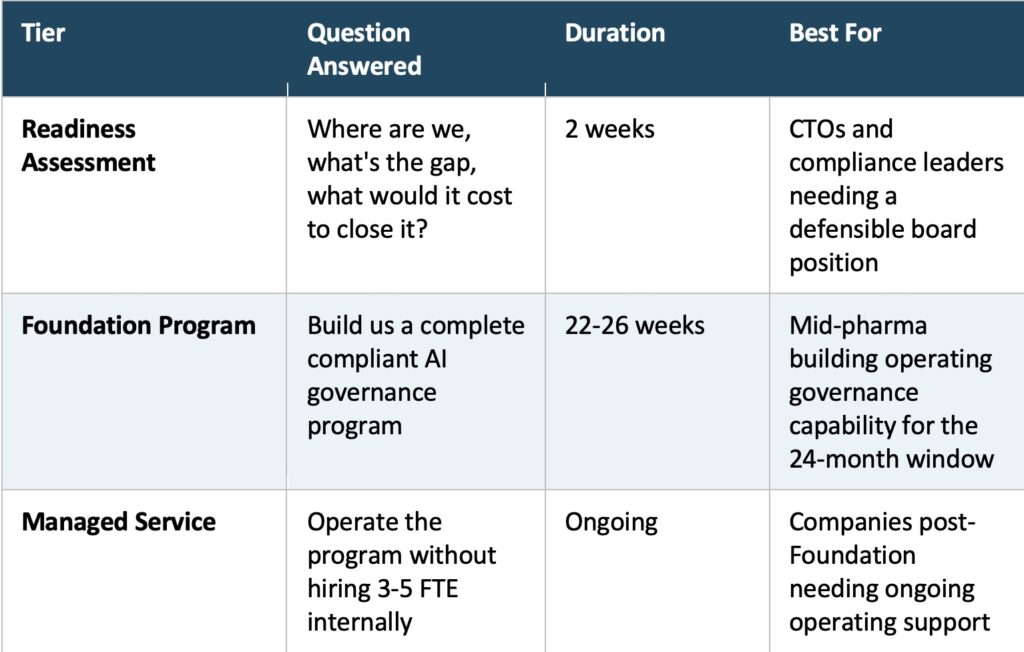
Big 4 firms typically run these engagements at $1.2M–$2.5M over 9–14 months – overkill for mid-pharma and slow. The Eularis Foundation Program delivers the same regulatory coverage in 22–26 weeks with a focused team of senior consultants. The efficiency comes from precision, not from cutting scope.
"The Board found it compelling — especially that while future-proofing the business we are delivering measurable milestones and results that reshape it at the same time."
Global Head of Planning, Strategy and Operations, Top 20 Pharma