

Enrolment isn’t a “soft” operational risk in drug development – it’s the hard constraint that quietly determines whether a promising asset reaches patients on time or bleeds value in limbo. In today’s clinical landscape, recruitment timelines are missed so routinely that it has become the norm rather than the exception, with widely cited analyses indicating that roughly 80% of trials experience delays driven by enrolment.
That slippage compounds fast: for Phase III programs, every day a study drifts can translate into $600,000 to $8 million in additional cost and lost opportunity, while patients wait longer for therapies that may materially change outcomes – and sponsors and sites burn effort on screen failures, rework, and avoidable amendments.
The uncomfortable truth is that traditional recruitment playbooks – manual chart review, broad outreach, and late-stage site course correction – were built for a simpler era; they are increasingly mismatched to protocols packed with narrow inclusion/exclusion criteria, higher data demands, and operational complexity that makes “finding the right patient at the right time” a precision problem, not a volume problem.
Understanding the Root Causes of Enrolment Delays
Enrolment delays are best understood as a compounded systems failure across data, design, geography, and site throughput – not a simple “recruitment” shortfall.
Start with patient identification: today’s eligibility definitions are increasingly specific (prior lines of therapy, biomarker status, washout windows, lab cutoffs, comorbidity exclusions), yet the evidence needed to confirm them is diffuse and inconsistently structured – split across EHRs, outside lab systems, imaging archives, specialty notes, and sometimes separate oncology practice platforms. What looks like a robust feasibility population on paper collapses during screening because key qualifiers are buried in unstructured text, missing from the local record, or time-dependent (e.g., “within 14 days”), forcing labour-intensive chart abstraction and repeat testing.
Then come awareness gaps, where large numbers of eligible patients never enter the funnel because trial options are not surfaced at the decision point: community physicians are not paid to be full-time trial navigators, trial availability changes weekly, and referral pathways often add friction – extra documentation, uncertain turnaround times, and perceived loss of continuity – so the “default” becomes standard of care even when a trial fits. Overlay geographic and demographic mismatches and the pool shrinks further: trials still cluster in academic centres with research infrastructure, while many eligible patients are treated in community settings or live far from sites; travel time, time off work, childcare, and transportation become silent exclusion criteria, disproportionately affecting rural populations and historically underrepresented groups.
Protocol complexity amplifies every weakness: with the average trial now carrying 20+ eligibility criteria, each additional condition reduces the addressable population nonlinearly, increases interpretation variability across sites (“clinically significant,” “stable,” “adequate”), and raises participant burden through extra visits and procedures – driving screen failures and pre-randomization drop-off.
Finally, even when patients are identifiable and interested, operational bottlenecks throttle throughput: slow screening cycles, long central lab turnaround, repetitive data entry, and coordinator overload turn enrolment into a queuing problem; and when sponsors select sites based on reputation or optimistic feasibility surveys rather than demonstrated access and capacity, they end up activating too many low-enrolling sites and adding “rescue” sites late – an expensive way to discover that enrolment is constrained less by intent than by the mechanics of moving the right patient through consent, screening, and randomization fast enough.
AI‑Powered Solutions Across the Enrolment Lifecycle (What Actually Moves the Needle)
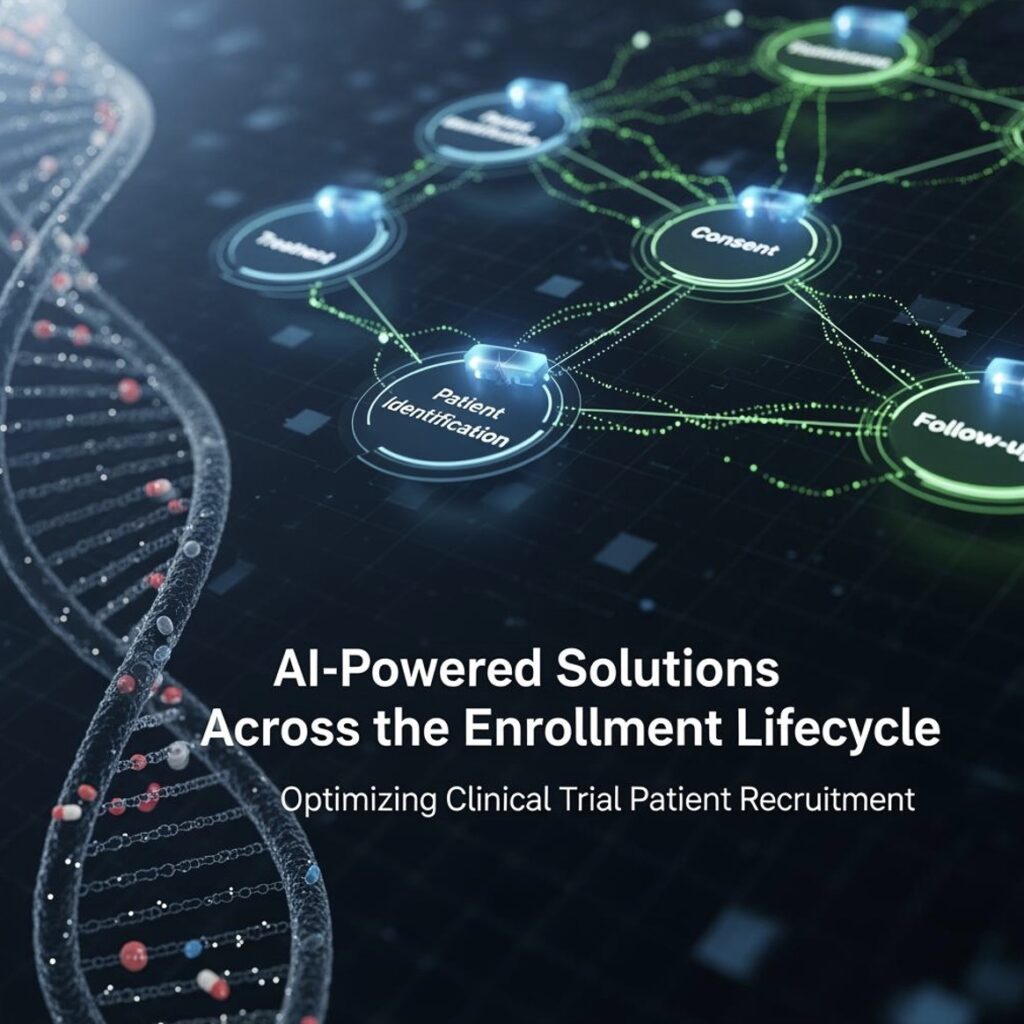
AI-Powered Solutions Across the Enrolment Lifecycle
AI can compress enrolment timelines only when it is applied as an end-to-end operating layer – not a point solution bolted onto a broken process. The highest-performing programs treat AI as a throughput engine: expanding the true eligible pool, improving the conversion rate from “possible” to “randomized,” and continuously reallocating resources as reality deviates from the plan. Here’s how that plays out across the lifecycle.
A) Patient Identification & Matching
Most “eligible patients” are invisible to traditional queries because the evidence sits in unstructured text – oncology staging in notes, biomarker interpretation in pathology narratives, imaging response language in radiology impressions, or medication histories in free-text plans. Clinical NLP turns that unstructured record into computable features and, critically, handles the nuances that break simple rules-based approaches:
● Context and negation: “No history of CHF” vs. “CHF exacerbation,” “rule out metastasis” vs. confirmed disease.
● Temporality: washout windows, “within 30 days,” progression on last line, “currently on” vs. “previously received.”
● Clinical synonyms and shorthand: regimen names, abbreviations, evolving terminology.
● Cross-document linking: aligning a biomarker result in pathology with a diagnosis in the problem list and an imaging confirmation in radiology.
The practical payoff is not just more leads, but fewer false positives that waste coordinator time. The best deployments output: (1) a ranked candidate list, (2) an “evidence packet” with the exact EHR snippets supporting each criterion, and (3) a clear “unknowns” list to resolve (e.g., missing ECOG, outdated labs). That last piece is what converts AI from interesting to operational.
Predictive modelling of patient propensity to enrol
Eligibility is necessary, not sufficient. Two patients who both qualify can have radically different likelihoods of consenting and making it to randomization.
Propensity models use historical and real-time signals – visit adherence, travel distance, prior trial participation, portal engagement, social determinants proxies, caregiver availability, language needs, comorbidity burden, time since diagnosis – to forecast conversion risk at each step (contact → pre-screen → consent → screen pass → randomized).
Used responsibly, these models do not gatekeep access; they help teams intervene earlier and tailor support:
● Flagging who needs transportation, flexible scheduling, or language-concordant navigation
● Predicting which criteria are most likely to fail given missing tests
● Prioritizing coordinator outreach when staffing is the constraint
The value is a measurable reduction in screen failures and “silent attrition,” plus faster time-to-first-patient-in.
B) Site Selection & Feasibility
Feasibility surveys and reputation-based site selection are notorious for optimism bias. ML can bring discipline by learning from prior trials: activation timelines, screen failure rates, coordinator-to-trial ratios, PI engagement, competing studies, patient flow by indication, data query burden, and retention patterns.
The strongest models separate performance into components:
● Speed to activate (contracts/IRB/start-up friction)
● Screening throughput (capacity and cycle time)
● Screen success (fit between protocol and local population)
● Retention (participant burden management, visit adherence)
This enables smarter portfolios: fewer “trophy sites,” more right-sized community sites, and earlier corrective action when predicted enrolment trajectories deteriorate. It also supports dynamic decisions – adding a site is not a last-minute panic move; it’s a planned trigger based on forecast variance.
Geospatial analytics for optimized site placement
Geospatial models overlay epidemiology, claims/RWD prevalence, referral patterns, travel times, public transit access, and demographic composition to design a site footprint that reflects where patients actually receive care. The insight here is simple but often ignored: distance is an exclusion criterion in practice.
Geospatial analytics helps answer:
● Where are the highest-density eligible clusters within realistic travel radii?
● Which regions have high prevalence but no trial access (equity gaps)?
● Which sites compete for the same small patient pool?
● Where would a mobile nursing network, satellite clinic, or hybrid model yield the biggest lift?
Done well, it increases both speed and representativeness – because the footprint is engineered rather than inherited.
C) Recruitment & Outreach
Enrolment loses candidates in the “interest-to-action” gap: patients search at night, ask questions, then drop off when the next human touchpoint is days later. Chatbots close that gap by providing immediate, consistent answers and guiding the patient to the next step.
High-value capabilities include:
● Plain-language protocol explanations (what happens, time commitments, randomization)
● Pre-screening for major inclusion/exclusion gates (with clear disclaimers)
● Scheduling and document collection initiation
● Escalation to human coordinators for sensitive questions
The key is governance: chatbot content must be medically accurate, non-coercive, and aligned with consent principles. When implemented correctly, they reduce coordinator burden while increasing qualified scheduled screenings.
Personalized digital marketing using clustering and recommendation engines
Broad outreach wastes money and can harm trust. AI-driven segmentation clusters patients by attributes that predict message relevance and channel preference – not just demographics. Recommendation engines can optimize which educational content to show, when, and where (search, patient communities, provider portals), then continuously learn which sequences convert to pre-screening.
The valuable nuance: in clinical trials, the “product” is a commitment under uncertainty.
Effective personalization therefore emphasizes:
● Disease-stage–appropriate framing (options, not desperation)
● Burden transparency (visits, procedures, travel)
● Trust signals (site credibility, patient support services)
● Culturally and linguistically adapted materials
This approach tends to increase conversion rates while lowering cost per enrolled patient.
D) Patient Engagement & Retention
Once consented, retention becomes the next enrolment problem – because dropouts reduce power and trigger replacement recruitment.
AI-enabled apps support participants with:
● Smart reminders that adapt to behaviour (not just rigid notifications)
● PRO collection with dynamic questioning to reduce fatigue
● Visit preparation checklists, transportation prompts, and medication guidance
● Passive data integration, where appropriate (wearables) to reduce visit burden
Operationally, these tools also improve data timeliness and reduce site follow-up chasing – an underappreciated driver of coordinator overload.
Sentiment analysis to pre-empt dropout risks
Participants often signal disengagement early – missed PROs, negative feedback, repeated questions about burden, and frustration in messages. Sentiment and pattern analysis can identify “risk states” before they become discontinuities.
The best programs convert insights into interventions:
● Proactive outreach by a navigator
● Scheduling flexibility or remote visit options
● Clarification of expectations and reassurance on side effects
● Escalation to clinician review when adverse experiences are suspected
The value is not only fewer dropouts, but fewer protocol deviations and cleaner datasets – both of which protect timelines.
E) Real-World Data (RWD) Integration
The greatest patient pools are distributed across institutions that cannot (and often should not) centralize raw data. Federated learning trains models across multiple sites while keeping patient data local – sharing model updates rather than records. In enrolment, this enables:
● More accurate feasibility by learning from diverse populations
● Cross-network patient identification without transferring PHI
● Reduced bias compared to single-institution models that reflect narrow demographics
The practical constraint is standardization: federated approaches still require consistent definitions (FHIR/CDISC mappings, phenotype logic) and tight governance for privacy, security, and auditability.
Synthetic control arms and digital twins to reduce reliance on large recruitments
Where scientifically and regulatorily appropriate, RWD-informed synthetic controls can reduce the number of patients assigned to control arms – making trials more attractive to patients and sometimes requiring fewer total participants. Digital twin approaches extend this by modelling expected trajectories under the standard of care to improve powering, enrich eligibility, or support adaptive designs.
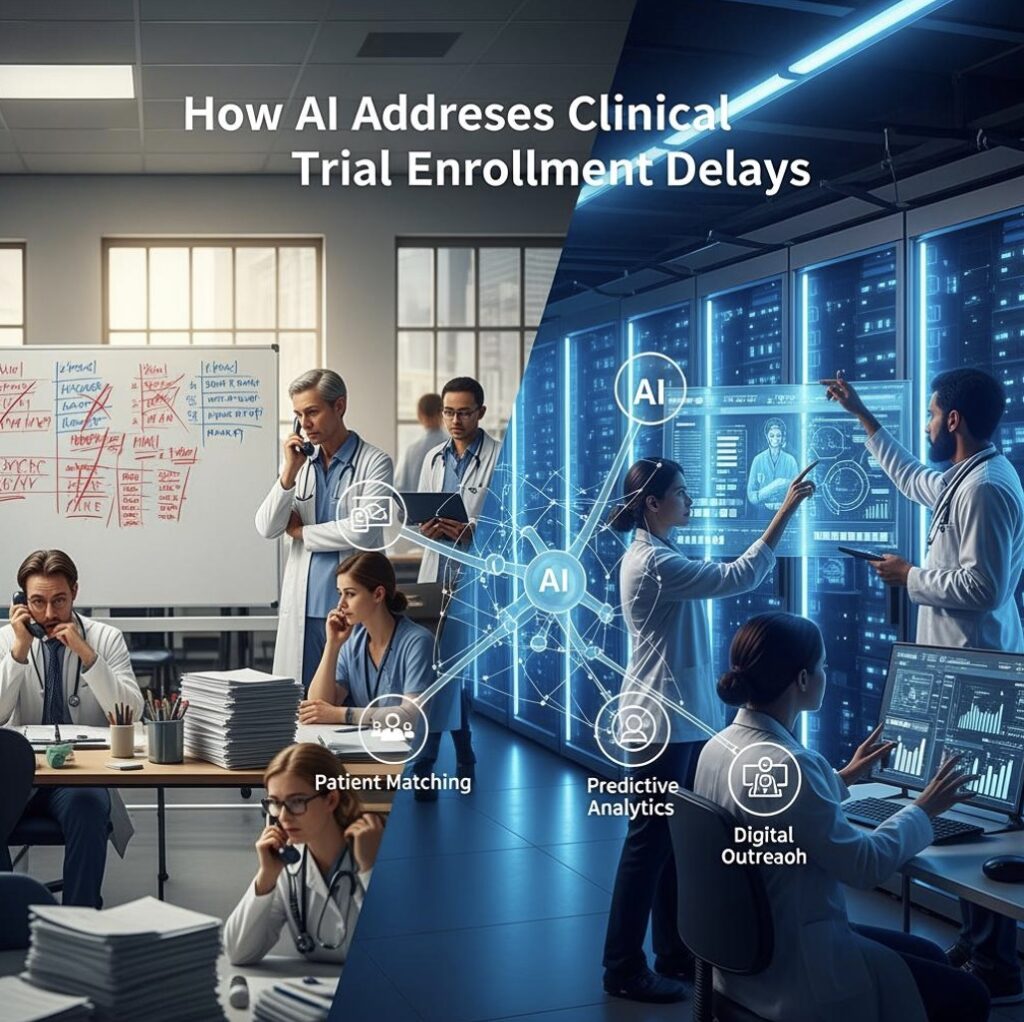
Quantifying Value: KPIs & ROI
If you can’t translate enrolment improvements into a small set of board-level metrics – speed, cost, data integrity, and representativeness – then “AI impact” remains anecdotal. The trick is to measure value the way trials actually succeed or fail: by eliminating cycle-time waste, reducing variance across sites, and increasing the probability that the enrolled population answers the scientific question without amendments, rescue sites, or costly extensions.
A) Time-to-first-patient-in and overall enrolment duration
What to measure (beyond the headline):
● Time to FPI = protocol final → first randomization. Treat this as a system readiness KPI, not a recruitment KPI.
● Time to first screened / first consented: isolates whether delays are in awareness/pre-screening vs. downstream screening logistics.
● Enrolment velocity: patients randomized per week (overall and per site), tracked against plan.
● Ramp curve: time to reach steady-state enrolment (e.g., 80% of peak weekly rate). Many trials “start” but never truly ramp.
● Forecast accuracy: variance between predicted and actual enrolment at weeks 4/8/12. This is the best early warning KPI.
How to interpret value:
● FPI is the earliest indicator that your trial is operationally executable. Improving FPI often reflects better site selection, faster start-up, and stronger pre-screening – not “better advertising.”
● Overall enrolment duration is where the economics compound. A small gain in weekly velocity (e.g., +10–20%) often beats adding more sites late, because it avoids dilution of coordinator attention and activation lag.
B) Cost savings per site and per patient enrolled
What to measure
Enrolment economics get distorted when teams only look at total spend. You need unit costs and waste metrics.
Core unit economics KPIs:
● Cost per randomized patient (gold standard): total enrolment-related costs divided by randomized patients.
● Cost per screened patient and screen failure cost: screening is often the hidden sink – labs, imaging, coordinator time, vendor fees.
● Cost per site activated and cost per enrolling site: many sites activate but enroll zero or one patient – pure leakage.
● Coordinator hours per randomized patient (or per screen): a throughput metric that correlates strongly with timelines.
Operational waste KPIs that drive savings:
● Screen failure rate (overall and by criterion): high rates usually point to overly strict criteria, poor pre-screening, or inaccurate feasibility.
● Non-enrolling/low-enrolling site percentage: if a meaningful fraction of sites enrol <2 patients, your feasibility and site strategy are misfiring.
● Cycle times: pre-screen → consent, consent → first screen visit, screen → randomization. Long cycle times inflate overhead and increase dropout risk.
C) Improvements in demographic diversity and statistical power
Diversity is not a PR metric; it’s an evidentiary risk metric. Underrepresentation can create uncertainty about safety/efficacy generalizability, increase post-marketing burden, and threaten payer/HTA confidence.
Diversity KPIs that matter:
● Representation ratio: enrolled share of a demographic group divided by disease prevalence share in the real-world target population (national and site-catchment–adjusted). This avoids misleading comparisons to census alone.
● Diversity enrolment velocity: weekly randomizations for underrepresented groups vs. plan. If you only measure end-state, you detect failure too late.
● Dropout and screen failure by subgroup: disparities here often reveal unequal burden, access barriers, or biased eligibility impacts.
● Geographic access coverage: proportion of target population within a realistic travel time to a participating site (or supported by decentralized options).
Link to statistical power (and why it’s financial):
● Power is driven by events and variance, not just N. If enrolment skews toward lower-risk, easier-to-reach patients, you can reduce event rates and inadvertently extend duration.
● Heterogeneity and subgroup precision: a more representative sample can reduce uncertainty for subgroup analyses and improve the credibility of labelling discussions – often affecting downstream adoption.
● Effective sample size: if retention is uneven across subgroups, your “planned N” is an illusion. Track completers and evaluable endpoints by demographic.
Implementation Challenges and Considerations
1) Data Quality and Interoperability
AI doesn’t fail first because algorithms are weak; it fails because the inputs are incomplete, inconsistent, or inaccessible. Eligibility signals are scattered across EHR modules, labs, imaging, pathology narratives, pharmacy systems, and scanned documents, often encoded differently by site and vendor. Without reliable mappings (e.g., to FHIR/CDISC/OMOP), clear data provenance, and rigor on missingness, models produce “confident” outputs that don’t survive coordinator reality – creating rework and eroding adoption.
The operational requirement is an interoperability plan that includes normalization, terminology alignment, and an explicit strategy for unstructured data (NLP) alongside structured fields – plus continuous monitoring for drift as sites change workflows or EHR configurations.
2) Regulatory and Privacy Constraints
Enrolment AI sits in a heavily regulated intersection: patient privacy law, clinical research oversight, and (in some cases) medical device regulation. Programs must design for HIPAA/GDPR principles (minimum necessary access, lawful basis/consent where applicable, auditable controls, retention limits) and be prepared for cross-border data restrictions.
On the research side, FDA expectations are evolving around model transparency, bias, and lifecycle management – especially when AI influences trial conduct (who is approached, how eligibility is interpreted, or how retention interventions are triggered).
The practical stance is to assume regulators will ask: What data was used? How is it protected? How is performance monitored over time? What happens when the model is wrong?
3) Validation and Trust
Retrospective AUCs don’t enrol patients; trust does. Investigators and IRBs need evidence that the tool improves identification and conversion prospectively, without introducing unfairness or undue influence.
That means pre-specified evaluation plans, real-world performance metrics (precision/recall on eligibility, screen-failure reduction, time saved), subgroup performance reporting, and clear accountability for decisions – AI should surface candidates with an evidence trail, not make opaque eligibility calls.
Trust also hinges on explainability calibrated to the user: coordinators need criterion-level evidence; IRBs need risk controls and fairness; sponsors need performance and auditability.
4) Change Management
The fastest way to kill an AI program is to add clicks to people who already can’t breathe – coordinators and site staff. Integration must be workflow-native (inside EHR/referral and CTMS processes where possible), with role-based outputs and minimal duplication.
Successful deployments treat adoption like an operations rollout: define who acts on AI outputs, set service levels (e.g., outreach within 24–48 hours), train on edge cases, and measure time savings – not just model performance. Importantly, AI should remove work (pre-populated evidence packets, automated pre-screen lists, smart scheduling prompts), not create a new parallel process.
5) Cost and Infrastructure Requirements
The investment is more than a software license. Real costs include data access agreements, integration/build, security and audit controls, model monitoring, clinical/NLP tuning, and ongoing governance – plus the internal change effort. ROI is real, but only when leaders quantify it in unit economics (cost per randomized patient, coordinator hours per randomization, screen failure costs, non-enrolling sites) and tie it to a realistic implementation scope (one indication, a defined network, clear KPIs).
The disciplined approach is phased: prove value in a controlled pilot with prospective metrics, then scale with standardized connectors, governance, and a durable operating model – rather than betting the program on a “big bang” deployment.

Future Directions and Emerging Possibilities
Federated Learning Approaches
The next step-change in enrolment performance won’t come from “more data” so much as more connected data – without violating privacy or institutional boundaries. Federated learning enables models to be trained across multiple health systems while patient-level data stays local, shifting the industry from one-off, site-specific tools to network-level intelligence.
Practically, this matters because the true eligible population is distributed: rare disease cohorts, biomarker-defined subgroups, and underserved communities rarely sit inside a single institution’s EHR. The strategic promise is twofold: better feasibility forecasting and patient finding at scale, and reduced bias versus models trained on narrow academic-centre populations.
The work ahead is operational, not theoretical: standardizing phenotypes, harmonizing coding (FHIR/OMOP/CDISC), and instituting governance that makes model updates auditable and clinically defensible.
Generative AI Applications
Generative AI will increasingly act as a “co-pilot” for protocol and recruitment design – but its value will depend on whether it is constrained by evidence and operational reality. In protocol development, the most credible use cases are structured drafting and stress-testing: generating inclusion/exclusion candidates from prior programs, flagging criteria likely to drive screen failure, summarizing precedent protocols, and drafting site manuals and patient materials with consistency.
In recruitment, the near-term impact is personalized, multilingual communication at scale – messages that reflect disease stage, visit burden, and local site logistics while maintaining non-coercive, consent-aligned language. The more transformative (and harder) frontier is adaptive trial operations: dynamically adjusting outreach, site allocation, and visit schedules based on live signals (screen failure reasons, cycle times, dropout risk) while keeping the adaptation rules pre-specified and regulator-ready.
The north star is speed without compromising scientific integrity; the risk is ungoverned content generation that introduces inaccuracies, inequities, or compliance exposure – so guardrails, source-citation, and approval workflows become core design requirements.
Integration with Real-World Evidence (RWE)
The boundary between “trial recruitment” and “post-market learning” is set to blur. As RWE pipelines mature, the same data assets that improve feasibility and identification can support continuous evidence generation – long-term outcomes, safety surveillance, and effectiveness in broader populations.
Done well, this creates a feedback loop: post-market signals inform the next protocol’s eligibility and endpoint selection, and recruitment becomes more precise because it is grounded in real-world care pathways rather than idealized assumptions.
The operational implication is that sponsors will need architectures that connect trial systems (CTMS/EDC/eCOA) with RWE sources (claims, registries, EHR networks) under a consistent governance model – so evidence doesn’t fragment across lifecycle stages and repeat the same interoperability failures.
Patient-centric Platforms
The most underexploited lever in enrolment is patient agency – making trial discovery feel less like being “recruited” and more like accessing an informed option. Emerging platforms will let patients’ permission their data, express preferences (travel radius, visit frequency tolerance, language needs, willingness for randomization), and use AI to match to trials with transparent explanations: why this trial fits, what the burden is, what alternatives exist.
The shift is meaningful; it moves from sponsor-driven outreach to patient-directed navigation, improving trust and reducing drop-off caused by surprises late in screening.
The winners here will pair matching accuracy with credibility – clear evidence sources, privacy controls, and human support (navigators) when decisions are complex – because in clinical research, the “user experience” is inseparable from ethics and informed consent.
The future is less about isolated AI tools and more about privacy-preserving collaboration, governed automation, and patient-first discovery – turning enrolment from a reactive scramble into a measurable, continuously learning operating system.
Conclusion
Enrolment won’t be “fixed” by AI in a single release or by any single vendor because the constraints are structural: protocol complexity, fragmented data, limited site capacity, and patient burden. The opportunity is also structural: when AI is built on high-quality data, prospectively validated, and embedded in real workflows, it can shorten time to first patient in, increase enrolment speed, reduce screen failures, and widen access beyond traditional academic centres – especially for historically underrepresented communities.
Faster enrolment turns promising hypotheses into clear answers sooner, reduces delays across the pipeline, and gets patients access to new options earlier.
Progress will come less from automation and more from alignment: technologists building for scientific and operational realities, sites and researchers shaping tools for feasibility and ethics, regulators setting clear transparency and lifecycle oversight expectations, and patient communities co-designing recruitment and support that earns trust. In that model, AI isn’t a shortcut – it’s an accelerant for clinical research that is faster, fairer, and more predictable.
Found this article interesting?
The organisations that improve enrolment speed are rarely the ones running the most pilots. They are the ones with a clear, governable, financially defensible AI strategy. If that gap is starting to show inside your organisation, Eularis can help you diagnose it and define the right next move. Start with a conversation.
For more information, contact Dr Andree Bates abates@eularis.com. or fill in our contact us form here,